


What's Happening?
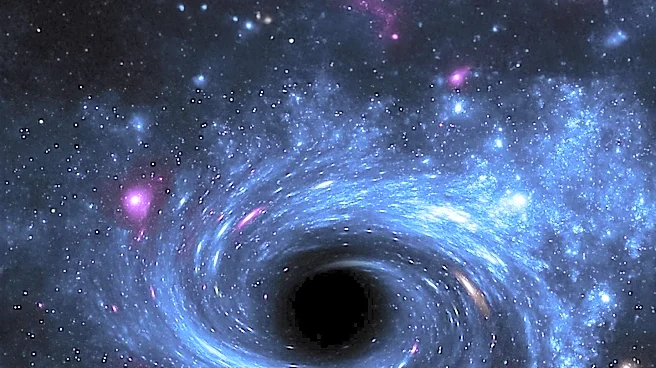
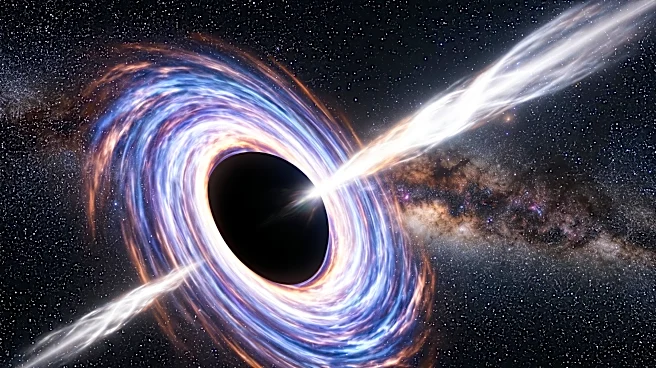
A citizen science initiative, 'Black Hole Hunters,' launched by the University of Southampton, is enlisting the public's help to identify hundreds of millions of black holes believed to exist in our galaxy but remain largely undetected. Traditional astronomical
methods struggle to find these black holes because they absorb light and are often invisible unless actively consuming a star. The project leverages Einstein's theory of general relativity, specifically the phenomenon of gravitational microlensing and self-lensing. Microlensing occurs when a black hole passes in front of a star, bending its light. Gravitational self-lensing, a rarer event, involves a black hole orbiting a companion star, causing periodic light bending. The 'Black Hole Hunters' project, originally started in 2021, has been relaunched with an improved data pipeline, now utilizing data from the Transiting Exoplanet Survey Satellite (TESS). TESS continuously captures light curves from hundreds of thousands of stars, providing an ideal dataset for detecting gravitational self-lensing. While AI algorithms are used to filter millions of light curves, human volunteers are crucial for final verification, as AI can be misled by phenomena like sunspots or sensor glitches. The project is currently 43% complete, with nearly 23,000 volunteers contributing almost 12 million classifications since October 2021.
Why It's Important?
The 'Black Hole Hunters' project is significant for several reasons. Firstly, it addresses a major discrepancy between theoretical predictions and observational evidence regarding the number of black holes in our galaxy. Stellar evolution models suggest hundreds of millions of black holes, yet only about 70 have been identified so far. Discovering these elusive objects is crucial for a more complete understanding of galactic structure, evolution, and the distribution of mass within the Milky Way. Secondly, the project highlights the power of citizen science in accelerating scientific discovery. By engaging a large number of amateur astronomers, the project can process vast amounts of data that would otherwise take decades for professional astronomers to analyze. This collaborative approach democratizes scientific research and fosters public engagement with astronomy. Thirdly, the methodology employed, combining advanced satellite data (TESS) with AI filtering and human verification, represents an innovative approach to astronomical data analysis. This hybrid model could serve as a blueprint for future large-scale scientific endeavors, particularly in fields with massive datasets. The identification of new black holes could also lead to new insights into their formation, properties, and their impact on surrounding celestial bodies.
What's Next?
The 'Black Hole Hunters' project is actively seeking more volunteers to complete its classification tasks, currently at 43% completion. A media blitz is underway to attract additional participants. As the project progresses and more potential black hole candidates are identified through gravitational self-lensing, the next step will involve directing more advanced telescopes to these specific areas for further observation and confirmation. This will allow astronomers to gather more detailed data on these newly discovered black holes, potentially leading to a significant increase in the known black hole population within our galaxy. The confirmed discoveries will contribute to refining stellar evolution models and our understanding of the universe's fundamental components. Furthermore, the success of this project could inspire the development of similar citizen science initiatives in other areas of astrophysics, leveraging public participation to tackle complex data analysis challenges. The project's findings will also inform future space missions and observational strategies aimed at black hole research.
Beyond the Headlines
Beyond the immediate goal of finding black holes, this project has broader implications for the scientific community and public understanding of science. Ethically, it raises questions about the role of citizen scientists in cutting-edge research and the balance between professional expertise and public contribution. It also underscores the importance of data accessibility and user-friendly interfaces (like the Zooniverse platform) to facilitate widespread participation. Culturally, the project fosters a sense of collective discovery and ownership in scientific endeavors, potentially inspiring a new generation of scientists and astronomers. The long-term shift could be towards a more integrated model of research where public engagement is not just a outreach activity but an integral part of the scientific process, especially for data-intensive fields. The project also subtly emphasizes the enduring relevance of theoretical physics, as Einstein's century-old theory of general relativity remains a cornerstone for detecting these invisible cosmic giants. The challenge of distinguishing genuine black hole signatures from astronomical noise, even with AI assistance, highlights the irreplaceable value of human pattern recognition and critical thinking in scientific exploration.