



What's Happening?
Scientists from Tokyo University of Science have successfully observed positronium behaving as a quantum matter wave for the first time. Positronium, a short-lived system composed of an electron and a positron, was shown to exhibit wave-like properties
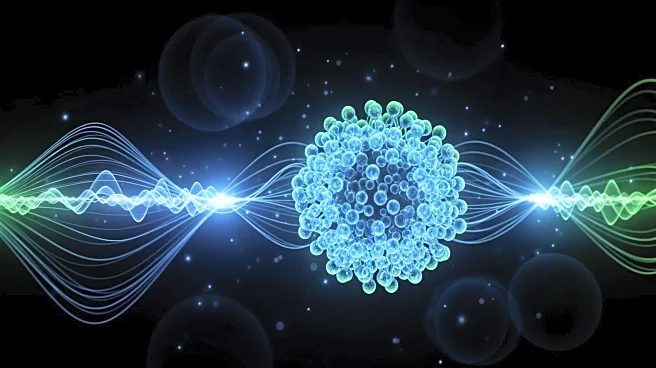
when a beam of it was directed through a graphene film, producing clear diffraction patterns. This experiment confirms the wave-particle duality of positronium, a fundamental concept in quantum mechanics. The research team, led by Professor Yasuyuki Nagashima, utilized a highly coherent positronium beam to achieve this result, marking a significant advancement in the study of quantum physics. The findings, published in Nature Communications, demonstrate that positronium behaves as a single quantum object, with the electron and positron not diffracting independently.
Why It's Important?
This breakthrough in observing positronium as a quantum matter wave has significant implications for fundamental physics. It provides a new avenue for precision measurements involving positronium, potentially leading to advancements in understanding quantum mechanics and antimatter. The ability to observe positronium's wave nature opens up possibilities for non-destructive, surface-sensitive analysis of materials, which could benefit industries reliant on material science and nanotechnology. Additionally, this research could pave the way for sensitive tests of gravity using antimatter, an area that remains largely unexplored. The findings contribute to the broader understanding of quantum systems and their applications in various scientific fields.
Beyond the Headlines
The observation of positronium as a quantum matter wave highlights the potential for future research in quantum physics and its applications. The experiment's success demonstrates the feasibility of using positronium for precision measurements, which could lead to new insights into the behavior of antimatter and its interactions with gravity. This research also underscores the importance of developing advanced experimental techniques and equipment, such as high-quality positronium beams and position-sensitive detectors. As scientists continue to explore the properties of quantum systems, the findings from this study may inspire further investigations into the fundamental nature of matter and the universe.