






What's Happening?
Scientists have identified the first dinosaur fossil from a remote western section of the Bayan Gobi Formation in China’s Inner Mongolia. The specimen, cataloged as 208GPV01, was unexpectedly recovered from a drill core at a depth of 473 meters (1,500
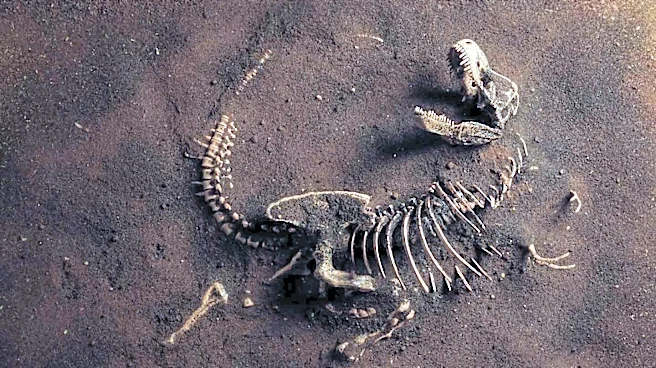
feet) near Guaizihu in the Yin’gen-Ejinaqi Basin during a copper mineral survey. Dating back approximately 115 million years to the Early Cretaceous epoch, the fossil primarily consists of proximal tail vertebrae along with several associated elements, including a sacral rib, four caudal vertebral centra, six caudal neural arches, several transverse processes, and ossified tendons. Researchers, including Dr. Lida Xing from the China University of Geosciences, determined that the specimen belongs to Ornithischia, a group of plant-eating, bird-hipped dinosaurs. While its vertebral proportions most closely resemble those of Psittacosaurus, the limited material prevents assignment to a specific genus or species, classifying it as an indeterminate ornithischian for now. This discovery, published in the journal Earth History and Biodiversity, significantly expands the known geographical range of dinosaur fossils within this important Early Cretaceous rock unit.
Why It's Important?
This discovery is crucial for understanding the geographical distribution and diversity of dinosaurs during the Early Cretaceous period in East Asia. Previous dinosaur finds in the Bayan Gobi Formation have almost exclusively come from the eastern part of the Yin’gen-Ejinaqi Basin. The recovery of 208GPV01 from the western section extends the known range of these ancient creatures, providing a more complete picture of their habitat and migration patterns. It also highlights the potential for unexpected paleontological discoveries in areas not traditionally explored for fossils, such as deep drill cores from mineral surveys. The identification of an ornithischian, possibly related to Psittacosaurus, reinforces the understanding of the Jehol Biota's radiation range, while also suggesting regional variations within this ancient ecosystem. This find contributes valuable data to the ongoing effort to reconstruct the paleogeography and paleoecology of Cretaceous China, offering new insights into the evolutionary history of bird-hipped dinosaurs.
What's Next?
The discovery of 208GPV01 opens new avenues for paleontological exploration in the western Yin’gen-Ejinaqi Basin. Future geological surveys and targeted paleontological expeditions in this region may yield more complete dinosaur fossils, which could help in definitively assigning the specimen to a specific genus or species. Further analysis of the geological context of the drill core could also provide more detailed information about the ancient environment in which this dinosaur lived. Researchers will likely continue to compare this fossil with other ornithischian species to refine its phylogenetic placement and understand its relationship to other known dinosaurs from the Jehol Biota. The success of this unexpected discovery may also encourage the integration of paleontological considerations into future mineral exploration projects, potentially leading to more accidental but significant fossil finds.
Beyond the Headlines
This discovery underscores the vastness of Earth's paleontological record and the serendipitous nature of scientific breakthroughs. The fact that a significant dinosaur fossil was found during a copper mineral survey, rather than a dedicated paleontological dig, highlights how interdisciplinary efforts can lead to unexpected and profound scientific insights. It also serves as a reminder that much of Earth's ancient history remains hidden beneath the surface, waiting to be uncovered through various means. The challenges of classifying a fossil based on limited material, as seen with 208GPV01, illustrate the meticulous and often conservative approach of paleontologists. This careful methodology ensures that conclusions are robust and based on solid evidence, even when faced with the excitement of a new discovery. The ongoing effort to map the distribution of ancient life forms contributes to a broader understanding of biodiversity and evolution over geological timescales.