



What's Happening?
The National Oceanic and Atmospheric Administration (NOAA) has adopted a new metric, the Relative Niño-3.4 Index, to more accurately measure the strength of El Niño and La Niña events in a warming climate. This change addresses a growing challenge where
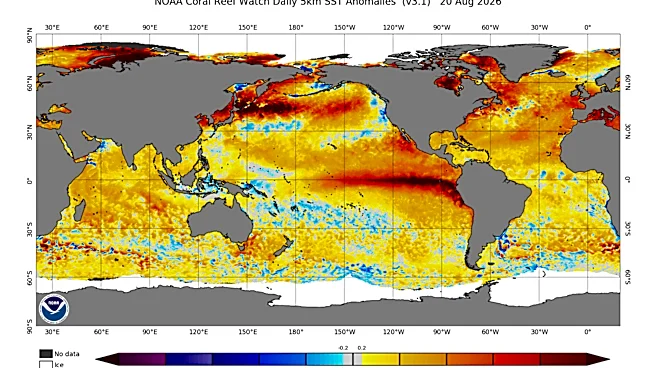
traditional measurements, which compare sea surface temperatures in the tropical Pacific to a long-term average, were becoming less reliable. In recent years, warming trends across the tropical oceans have complicated the relationship between central tropical Pacific surface temperatures and atmospheric responses. For instance, strong El Niño-like sea surface temperatures (Niño-3.4 index values) were observed with weaker atmospheric responses, as seen in 2023–24. Conversely, relatively weak La Niña events (cooler-than-average sea surface temperatures) in 2024–25 exhibited stronger atmospheric changes than expected. The new Relative Niño-3.4 Index compares the surface temperature anomaly in the Niño-3.4 region to the average anomaly across the entire tropical oceans, providing a more nuanced understanding of El Niño's true strength.
Why It's Important?
This shift in measurement is crucial for improving the accuracy of El Niño and La Niña forecasts and understanding their real-world impacts. When the entire tropical ocean is warmer than average, the atmospheric response to a warm Niño-3.4 region can be muted, leading to misinterpretations of an event's potential severity. By accounting for the broader tropical ocean temperature, the Relative Niño-3.4 Index helps isolate the specific El Niño-Southern Oscillation (ENSO) signal from the background of global warming. This improved accuracy is vital for various sectors, including agriculture, disaster preparedness, and resource management, as stronger El Niño events are more likely to produce expected winter precipitation, snow, and temperature patterns. Better predictions allow for more effective planning and mitigation strategies, potentially reducing economic losses and safeguarding communities from climate extremes.
What's Next?
NOAA's adoption of the Relative Niño-3.4 Index means that future predictions and historical records will reflect this new, more precise measurement. This will enable scientists to better distinguish the effects of ENSO from the overarching influence of climate change. The ongoing research and refinement of climate models will continue to incorporate these new insights, aiming for even more accurate and reliable forecasts. While stronger El Niño events are now more likely to align with expected winter weather patterns, the inherent variability of winter weather means that each event will still have unique characteristics. Continuous monitoring and analysis using this new metric will be essential to track how ENSO events evolve in a warming world and to provide timely warnings to affected regions, particularly in the contiguous United States, where El Niño can significantly influence seasonal precipitation and temperature.
Beyond the Headlines
The introduction of the Relative Niño-3.4 Index highlights a fundamental challenge in climate science: how to accurately assess natural climate variability in an era of rapid global warming. As the planet warms, the baseline conditions against which climate phenomena are measured are constantly shifting. This new metric represents an adaptive approach to climate monitoring, acknowledging that traditional methods may no longer fully capture the complexities of a changing climate. It underscores the idea that climate change is not just about rising average temperatures but also about altering the dynamics and impacts of existing weather patterns. This has broader implications for how climate data is interpreted and communicated to the public and policymakers. It also emphasizes the need for continuous innovation in climate science to develop tools and methodologies that can effectively address the evolving challenges posed by a warming world, ensuring that scientific understanding keeps pace with environmental changes.