







What's Happening?
Scientists at the Harvard & Smithsonian Center for Astrophysics have created Lumina, the largest and most detailed cosmological radiation-hydrodynamics simulation to date. This model recreates the first two billion years of the universe, illustrating
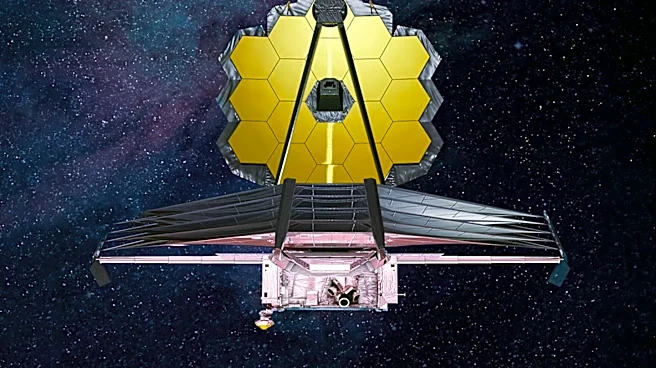
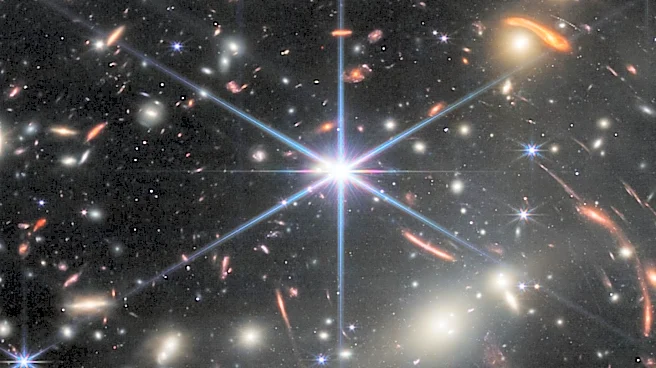
how ordinary matter, dark matter, and radiation interacted to form stars and galaxies. Lumina covers a vast volume of space, approximately 1.5 billion light-years on each side, which is over 100 times larger than previous comparable simulations. It is the first simulation to accurately capture helium reionization as it occurred, allowing its effects to influence the evolving universe within the model. The simulation was generated using over 15,000 graphics processing units on Frontier, one of the world's fastest supercomputers located at Oak Ridge National Laboratory in Tennessee. Lumina integrates data from the James Webb Space Telescope (JWST) and the Nancy Roman Space Telescope (NRST) to provide unprecedented detail.
Why It's Important?
The Lumina simulation is a significant advancement in astrophysics, offering a powerful tool to test theories about the early universe and the fundamental laws governing its evolution. By accurately modeling the interactions of gas, dark matter, and light, Lumina can help scientists understand how cosmic structures like stars and galaxies first formed. This detailed simulation allows researchers to translate theoretical predictions into observable phenomena, which can then be compared with actual telescope data. The ability to capture helium reionization for the first time provides crucial insights into a key period of cosmic history. This research is vital for refining our understanding of the universe's origins and could lead to new discoveries about dark matter and dark energy, which are central to modern cosmology.
What's Next?
The Lumina simulation will be used to test existing theories about the cosmos's evolution following the Big Bang. Scientists can now use this detailed model to validate or revise their understanding of the universe's fundamental laws. The predictions generated by Lumina will either bolster confidence in current theories or indicate areas where further research and adjustments are needed. The simulation's ability to model the cosmic web, where fine filaments represent dark matter, will provide a clearer picture of how matter is distributed throughout the universe. Future observations from telescopes like JWST and NRST will be crucial in verifying Lumina's predictions, potentially leading to a more complete and accurate cosmological model.
Beyond the Headlines
The development of Lumina highlights the increasing reliance on advanced computational power and interdisciplinary collaboration in scientific research. The use of supercomputers like Frontier underscores the scale of data processing required to simulate complex cosmic phenomena. This simulation not only pushes the boundaries of our understanding of the universe but also demonstrates the capabilities of modern technology in scientific exploration. The insights gained from Lumina could have profound implications for theoretical physics, potentially leading to new frameworks for understanding gravity, matter, and energy. Furthermore, by making the simulation available to the scientific community, the Harvard & Smithsonian Center for Astrophysics is fostering a collaborative environment that could accelerate future discoveries in cosmology.