


What's Happening?
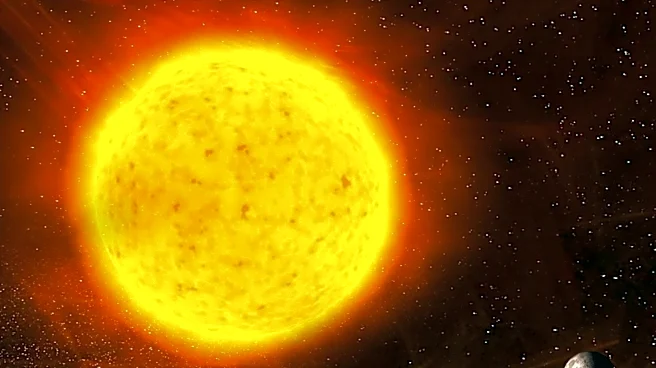
Sunlight, which takes just over eight minutes to reach Earth from the Sun, actually begins its journey thousands of years earlier within the Sun's core. The process involves photons being generated in the Sun's core and undergoing a 'random walk' through
the dense plasma, where they are absorbed and re-emitted multiple times before reaching the surface. This journey can take approximately 170,000 years, according to astrophysicists Robert Mitalas and Kenneth Sills. Once the photons reach the Sun's surface, they travel the remaining 93 million miles to Earth in a matter of minutes.
Why It's Important?
Understanding the journey of sunlight from the Sun's core to Earth provides insight into the complex processes occurring within our star. This knowledge is crucial for astrophysics, as it helps refine models of solar behavior and energy transfer. The study of photon diffusion also highlights the intricate balance of forces within the Sun, which has implications for solar energy research and understanding stellar lifecycles. Additionally, the presence of extragalactic photons reaching Earth underscores the vastness of the universe and the interconnectedness of cosmic events.
Beyond the Headlines
The concept of sunlight's long journey before reaching Earth challenges common perceptions of time and distance in space. It also raises questions about the nature of light and energy transfer in the universe. The study of extragalactic background light, which includes photons from distant galaxies, offers a glimpse into the history of the universe and the formation of galaxies. This research contributes to a broader understanding of cosmic evolution and the role of light in shaping the universe.