






What's Happening?
Ford CEO Jim Farley has issued a warning that the United States is at risk of falling behind global competitors if it does not prioritize investment in skilled trades. Speaking at Ford's Accelerate gathering in Detroit, Farley highlighted that countries
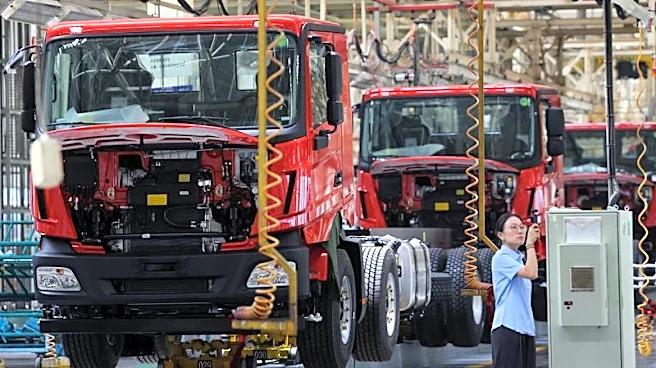
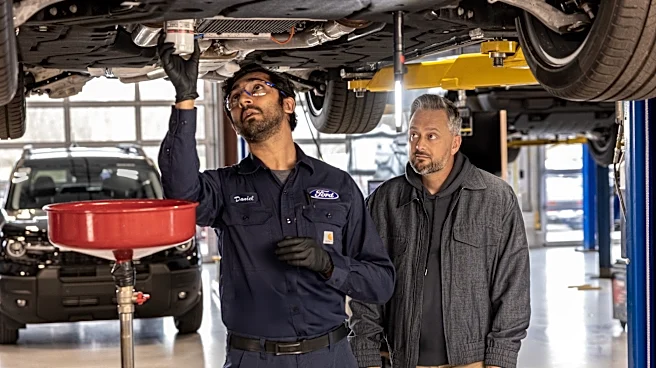
like Germany, China, and South Korea have significantly outpaced the U.S. in prioritizing apprenticeships and workforce development within the 'essential economy,' which includes sectors such as construction, manufacturing, energy, transportation, logistics, and public services. His remarks coincide with a new report projecting that the U.S. will need to fill 1.7 million skilled trades positions annually through 2035 due to job growth and worker replacement. The report, published by the Ford-backed Alliance for America's Skilled Trades, indicates that current training initiatives are only producing 55 workers for every 100 openings, with completion rates for apprenticeship programs exceeding 90% compared to roughly 50% for other skilled trades training. Farley emphasized the necessity of aligning career pathways and expanding high-quality apprenticeships to sustain a robust industrial base.
Why It's Important?
The warning from Ford CEO Jim Farley underscores a critical challenge for the U.S. economy and national security. A deficit in skilled trades workers directly impacts the nation's industrial base, potentially hindering its ability to compete globally in manufacturing, technology, and infrastructure development. The projected annual need for 1.7 million skilled trades positions highlights a significant gap between workforce demand and supply, which could lead to increased production costs, delays in critical projects, and a reliance on foreign expertise. This situation affects various U.S. industries, from automotive and construction to energy and logistics, all of which depend on a robust skilled workforce. Without adequate investment in training and apprenticeships, the U.S. risks ceding its competitive edge to nations that have already prioritized these areas. The issue also has societal implications, as skilled trades offer pathways to well-paying jobs without the burden of significant student debt, as noted by industry professionals. Addressing this gap is crucial for maintaining economic resilience and ensuring the country's capacity for innovation and production.
What's Next?
In response to the growing skilled trades gap, Ford CEO Jim Farley outlined several key actions needed to address the challenge. These include designing comprehensive career pathways that reach students, parents, and career changers earlier, expanding apprenticeships and high-quality training programs tied to employer needs, and providing support such as childcare and transportation to ensure completion. Farley also stressed the importance of breaking down silos between employers, schools, unions, and government entities to foster cross-sector collaboration. He called for a blockbuster public service campaign, similar to historical campaigns, to shift perceptions and highlight the value of skilled trades. Furthermore, he emphasized the need to make the issue personal by spotlighting successful skilled workers and their mentors. These initiatives aim to build stronger talent pipelines and ensure the U.S. can meet the projected demand for skilled workers, thereby strengthening its industrial base and national security. The Ford-backed Alliance for America's Skilled Trades will continue to advocate for these changes, with a commitment to review progress at future summits.
Beyond the Headlines
The discussion around skilled trades extends beyond immediate economic concerns, touching upon deeper societal and educational implications. The emphasis on vocational training and apprenticeships challenges the traditional American focus on four-year college degrees as the primary path to success. By highlighting the robust job stability and avoidance of student debt offered by skilled trades, there's a potential for a cultural shift in how these careers are perceived, especially among younger generations. Social media is already playing a role in this, showcasing accomplished technicians and entrepreneurs, making these fields more appealing. This re-evaluation of career pathways could lead to a more diversified and resilient workforce, better equipped to handle technological advancements like AI, which Farley noted will complement skilled trades rather than replace them. The call for a national public service campaign suggests a recognition that a fundamental change in public perception is required to attract talent to these essential roles, ultimately fostering a more balanced and economically secure society.