






What's Happening?
A historical report from 1951, titled 'Document of the Week: Veto Powers on the UN Security Council,' has been highlighted by the British Online Archives. This document details the formal and informal mechanisms through which the permanent members of the United
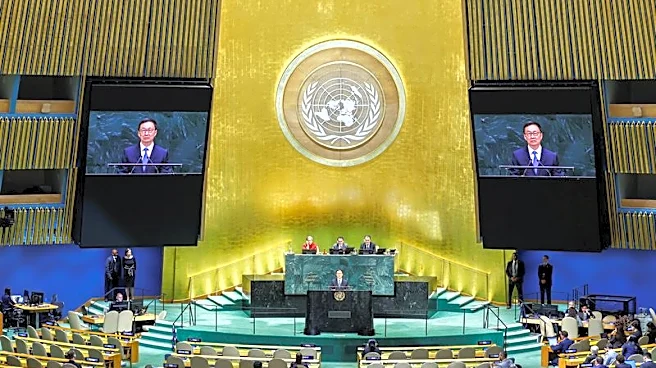
Nations (UN) Security Council—Britain, China, France, the Soviet Union, and the United States—exercised their veto power. The UN was established after World War II as a successor to the League of Nations, with the goal of fostering international cooperation and preserving peace. The five most powerful states in 1945, who founded the UN, sought to ensure the new organization reinforced their power rather than challenging it. Consequently, they appointed themselves as permanent members of the Security Council, the UN's primary decision-making body, and instituted a protocol requiring unanimous support for any decision. This rule effectively granted each permanent member a veto, which proved particularly problematic during the early Cold War due to the fractious geopolitical environment.
Why It's Important?
The examination of the UN Security Council's veto powers from a 1951 perspective offers crucial insights into the foundational dynamics of international diplomacy and global governance. The document underscores how the initial structure of the UN, designed to prevent a repeat of the League of Nations' failures, simultaneously embedded a mechanism that could, and often did, lead to gridlock. For the United States, as one of the permanent members, this historical context illuminates the long-standing influence and responsibilities associated with its position. The veto power has allowed the U.S. to protect its national interests and those of its allies on the global stage, but it has also been a point of contention, often criticized for hindering effective responses to international crises. Understanding these historical precedents is vital for comprehending current debates about UN reform and the balance of power among nations, impacting U.S. foreign policy and its role in multilateral institutions.
What's Next?
While the document itself is historical, its re-examination could fuel ongoing discussions about the structure and efficacy of the UN Security Council. Debates surrounding the veto power, its use, and potential reforms are perennial topics within international relations. Major stakeholders, including the U.S. government, other permanent members, and non-permanent member states, will likely continue to engage in dialogues about how the Security Council can be made more representative and effective in addressing contemporary global challenges. The historical context provided by this document may inform future policy considerations regarding U.S. engagement with the UN, potentially influencing diplomatic strategies and alliances. The implications extend to how the U.S. navigates its leadership role in a world where the geopolitical landscape has significantly evolved since the mid-20th century.
Beyond the Headlines
The 1951 report on veto powers delves into the deeper implications of how international organizations are designed to balance the ideals of collective security with the realities of great power politics. The ethical dimension lies in the tension between the principle of sovereign equality among nations and the disproportionate influence wielded by a few permanent members. Legally, the veto mechanism, while enshrined in the UN Charter, has been a subject of continuous interpretation and debate regarding its legitimate scope and application. Culturally, the document reflects the post-World War II mindset, where the victors sought to institutionalize their dominance to prevent future global conflicts. This historical perspective highlights how the initial design choices of international bodies can have long-lasting effects, shaping global power dynamics and influencing the effectiveness of multilateral efforts to address issues ranging from peace and security to human rights and economic development. The U.S.'s historical and ongoing role in this framework is a critical aspect of its global identity and foreign policy.