


What's Happening?
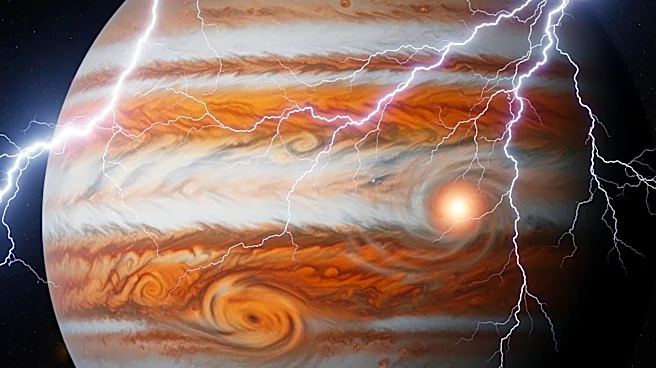
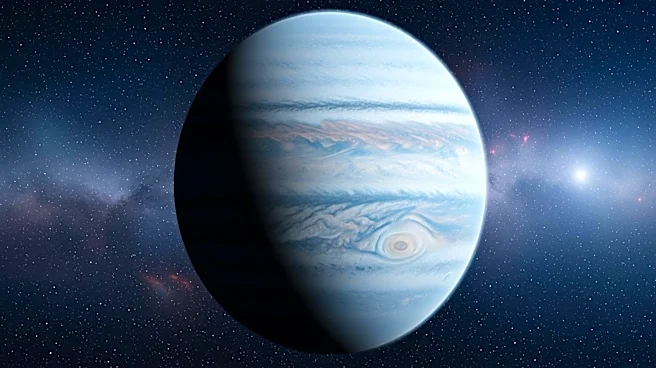
A recent study published in AGU Advances has unveiled that lightning storms on Jupiter possess energies far exceeding those on Earth. This discovery was made possible through precise spacecraft measurements and advanced analysis, which allowed researchers
to estimate the power of Jovian lightning directly. The study highlights that Jupiter's storms are not only larger but also fundamentally different in how they generate and release energy. The research was led by Michael Wong, a planetary scientist at UC Berkeley's Space Sciences Laboratory. The findings suggest that Jupiter's towering storm systems create longer pathways for electrical discharge, allowing energy to accumulate to much greater levels before being released. This results in lightning that is not only larger in scale but potentially governed by entirely different physical processes compared to Earth.
Why It's Important?
The study of Jupiter's lightning storms provides significant insights into the atmospheric physics of giant planets, which differ greatly from those on Earth. Understanding these extreme weather conditions can enhance our knowledge of planetary atmospheres and the processes that drive them. The research also underscores the importance of studying other planets to gain a better understanding of atmospheric phenomena that are not fully understood on Earth. This could have implications for future space exploration and the study of exoplanets, as it provides a natural laboratory for observing electrical storms under extreme conditions.
What's Next?
Further exploration and research are needed to fully understand the mechanisms behind Jupiter's intense lightning storms. Scientists will continue to analyze data from spacecraft like NASA's Juno, which has been instrumental in providing detailed observations of Jupiter's atmosphere. Future missions may focus on capturing more precise data to unravel the complexities of these storms and their underlying processes. This ongoing research could lead to new discoveries about the dynamics of planetary atmospheres and contribute to the broader field of planetary science.