





What's Happening?
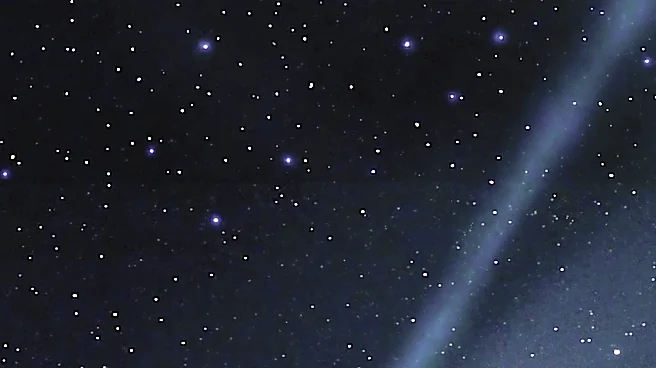
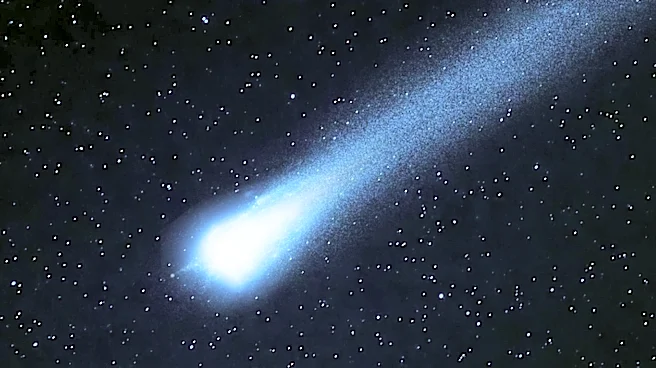
Comet 10P/Tempel 2 has been observed with a distinct needle-thin dust trail as it crosses the constellation Capricornus, heading towards its perihelion on August 2. This dust trail, unlike a traditional comet tail, is composed of particles that have accumulated
in the comet's orbit over time. Such features were first detected in the solar system in 1983 by NASA's Infrared Astronomical Satellite (IRAS), with Tempel 2 being one of the first comets to exhibit this phenomenon. The recent observations were made using an 11-inch f/2.2 astrograph, capturing one hour of exposure in LRGB filters.
Why It's Important?
The observation of Tempel 2's dust trail provides valuable insights into the behavior and composition of comets. Understanding the formation and characteristics of these dust trails can help scientists learn more about the history and evolution of comets in our solar system. This knowledge is crucial for developing models of solar system formation and for predicting the behavior of other comets. Additionally, studying these trails can offer clues about the distribution of dust and other materials in the solar system, which can have implications for planetary science and the study of cosmic dust.