
What's Happening?
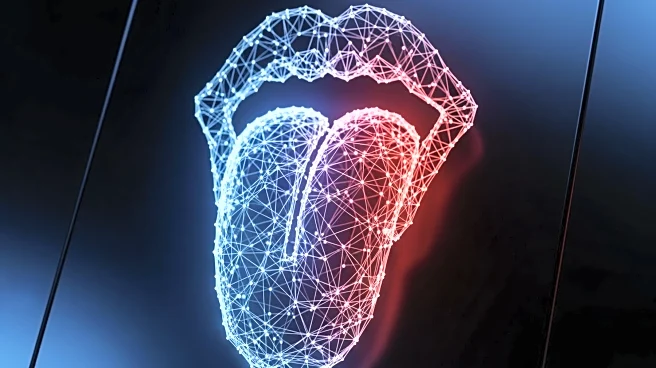
A recent study has demonstrated the potential of artificial intelligence (AI) in diagnosing and predicting coronary artery disease (CAD) through tongue image analysis. The research involved capturing high-resolution
images of patients' tongues using a specialized device, followed by AI-driven analysis to identify features such as fissures, wetness, and red spots. These features were then used to predict the severity of CAD. The study utilized a combination of deep learning models, including the Segment-Anything Model (SAM) and DeepLabV3+, to accurately segment and analyze tongue images. The AI models were trained on a dataset of over 1,000 annotated tongue images, allowing for precise feature extraction and disease prediction.
Why It's Important?
This development is significant as it offers a non-invasive, cost-effective method for early detection of coronary artery disease, which is a leading cause of death globally. By leveraging AI, healthcare providers can potentially improve diagnostic accuracy and patient outcomes. The use of tongue image analysis could also facilitate remote monitoring and diagnosis, making healthcare more accessible, especially in regions with limited medical resources. The integration of AI in medical diagnostics represents a shift towards more personalized and efficient healthcare solutions, potentially reducing the burden on healthcare systems and improving patient care.
What's Next?
The study's findings suggest further research and development could enhance the accuracy and applicability of AI-driven diagnostics. Future steps may include expanding the dataset to include more diverse populations and refining the AI models to improve their predictive capabilities. Additionally, clinical trials could be conducted to validate the effectiveness of this diagnostic method in real-world settings. As AI technology continues to evolve, its integration into healthcare could lead to more innovative diagnostic tools and treatment options.
Beyond the Headlines
The use of AI in medical diagnostics raises important ethical and legal considerations, such as data privacy and the need for regulatory frameworks to ensure the safe and effective use of AI technologies. There is also a cultural dimension, as traditional medicine practices, like those referenced in the study, are integrated with modern AI techniques. This fusion of traditional and modern approaches could lead to new insights and advancements in medical science.