



What's Happening?
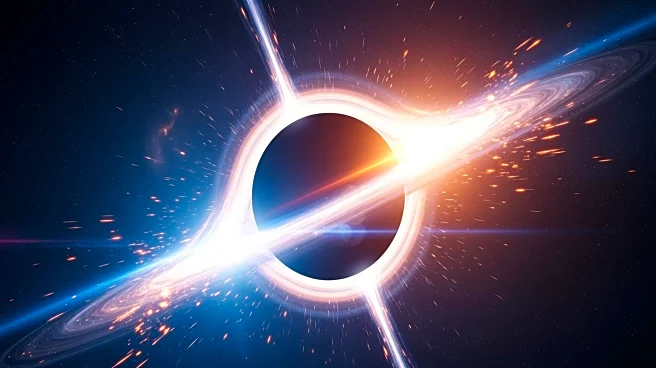
In a groundbreaking observation, astronomers have recorded a supermassive black hole in the galaxy NGC 3783 emitting a flare that triggered a high-speed outflow, known as an ultrafast outflow (UFO). This event, captured by the XMM-Newton and XRISM observatories,
marks the first time the onset and evolution of such a flare and its resulting outflow have been observed. The black hole, located about 130 million light-years away, is consuming material at a rapid rate, causing the galactic center to emit intense X-rays. The flare is believed to have been caused by a magnetic field filament snapping and reconnecting, similar to solar flares but on a much larger scale.
Why It's Important?
This observation is crucial for understanding the behavior of supermassive black holes and their impact on their host galaxies. The ability to observe the formation of ultrafast outflows provides insights into the processes that govern the dynamics of AGNs. These findings suggest that the physical processes in black holes may mirror those in our own solar system, offering a new perspective on the universality of such phenomena. The research underscores the importance of advanced space telescopes in uncovering the mysteries of the universe.
What's Next?
The next steps involve further analysis of the data collected to understand the mechanisms driving these ultrafast outflows. Researchers will likely focus on identifying similar events in other galaxies to determine if this is a common occurrence. The continued development of more sensitive instruments will enhance the ability to detect and study such phenomena, potentially leading to new discoveries about the universe's structure and evolution.