



What's Happening?
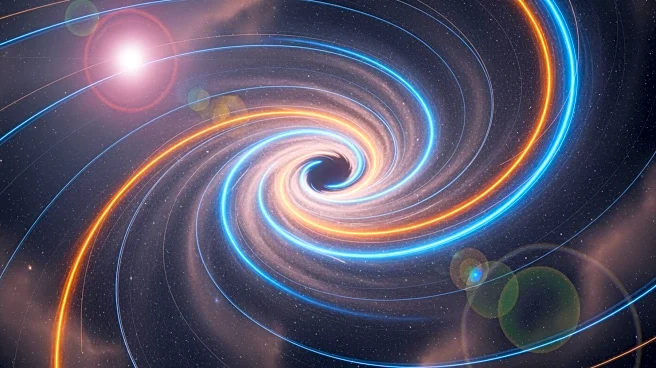
Astronomers have observed a rare cosmic event where a supermassive black hole is tearing apart a star, providing clear evidence of a phenomenon known as Lense-Thirring precession, or frame dragging. This effect, predicted by Einstein's theory of general
relativity, occurs when a rapidly spinning black hole twists space and time around it. The observation was made during a tidal disruption event (TDE) named AT2020afhd, where a star is pulled into a black hole's gravitational field, leading to its destruction. Researchers used X-ray data from NASA's Neil Gehrels Swift Observatory and radio waves from the Karl G. Jansky Very Large Array to study the event. The findings confirm that the black hole's rotation drags space-time, causing a wobble in the motion of the accretion disk and jet formed by the disrupted star.
Why It's Important?
This discovery is significant as it provides the most convincing evidence yet of frame-dragging, a key prediction of general relativity. Understanding this effect helps scientists learn more about the behavior of black holes, including how they rotate and interact with surrounding matter. The study of TDEs, like AT2020afhd, offers insights into the extreme gravitational forces at play near black holes and the processes that lead to the formation of powerful jets. These findings could advance our knowledge of cosmic phenomena and the fundamental laws governing the universe, potentially impacting fields such as astrophysics and cosmology.
What's Next?
Further research is expected to delve deeper into the physical processes behind frame-dragging and its implications for black hole dynamics. Scientists may continue to observe similar events to gather more data and refine their models. This could lead to a better understanding of the role of black holes in galaxy formation and evolution. Additionally, the study of frame-dragging might inspire new theoretical developments in physics, potentially leading to breakthroughs in our understanding of space-time and gravity.
Beyond the Headlines
The confirmation of frame-dragging around black holes highlights the ongoing relevance of Einstein's theories in modern astrophysics. It underscores the complexity of cosmic phenomena and the need for advanced observational technologies to explore them. This discovery also raises questions about the limits of current scientific knowledge and the potential for new discoveries in the universe. As researchers continue to explore these mysteries, they may uncover new principles that challenge existing theories and expand our understanding of the cosmos.