



What's Happening?
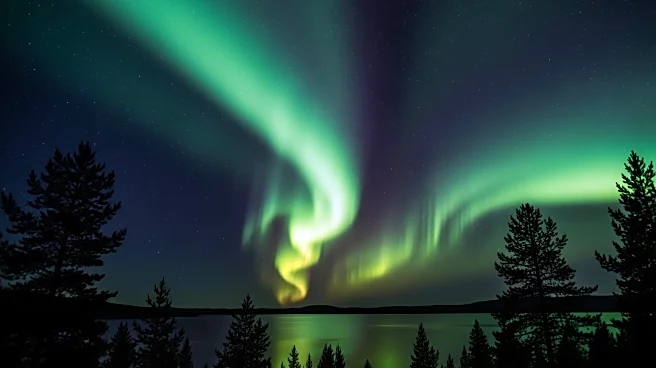
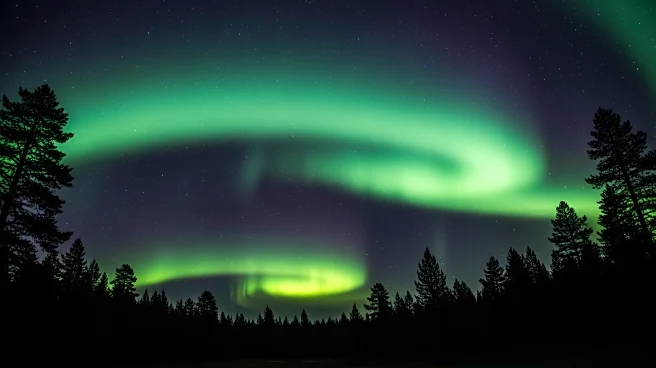
The National Oceanic and Atmospheric Administration's Space Weather Prediction Center (SWPC) has forecasted that the northern lights will be visible across ten U.S. states tonight, March 9. This phenomenon is due to lingering fast solar winds impacting
Earth's magnetic field. The states with the best chance of witnessing the auroras include Alaska, Washington, Idaho, Montana, North Dakota, South Dakota, Minnesota, Wisconsin, Michigan, and Maine. The U.K.'s Met Office is also monitoring a coronal mass ejection (CME) that was launched on March 6, which might pass close to Earth today, potentially enhancing geomagnetic activity. For optimal viewing, it is recommended to head outside between 10 p.m. and 2 a.m. local time, find a north-facing point with a clear horizon, and avoid light pollution.
Why It's Important?
The visibility of the northern lights in these states presents a rare opportunity for residents to experience this natural spectacle without traveling to typically more northern latitudes. This event highlights the dynamic interactions between solar activity and Earth's magnetic field, offering educational insights into space weather phenomena. Additionally, such events can boost local tourism as enthusiasts and photographers may travel to these areas to capture the auroras, potentially benefiting local economies. The occurrence of the northern lights also underscores the importance of monitoring space weather, as geomagnetic storms can have implications for satellite operations and power grids.
What's Next?
If the coronal mass ejection does impact Earth, it could lead to increased geomagnetic activity, possibly resulting in more intense auroras. As the spring equinox on March 20 approaches, the likelihood of auroras may increase due to the alignment of Earth's magnetic field with the solar wind. This period could provide additional opportunities for viewing the northern lights. Continued monitoring by space weather agencies will be crucial to provide timely updates and forecasts for future auroral displays.