
What's Happening?
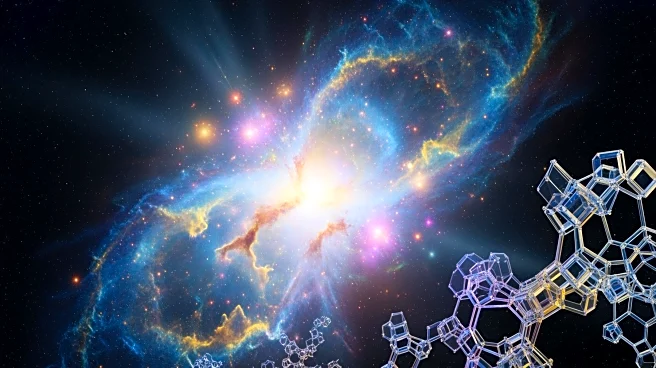
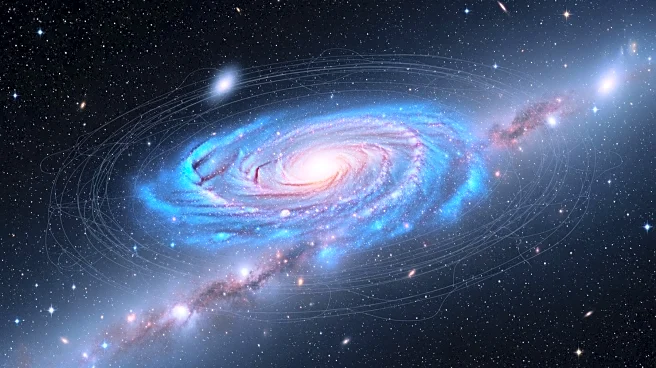
NASA's James Webb Space Telescope has produced a new high-resolution map of distant galaxies, offering fresh insights into the mysterious substance known as dark matter. This map, which is the most detailed
of its kind, covers a large section of the sky and includes nearly 800,000 galaxies, some of which have been observed for the first time. The map reveals how dark matter, which does not emit or absorb light, influences the distribution of ordinary matter in the universe. By observing the gravitational effects of dark matter on visible matter, scientists can better understand its role in the cosmic structure. The map, published in the journal Nature Astronomy, highlights the interconnectedness of galaxy clusters and the strands of dark matter that form the universe's skeleton.
Why It's Important?
The new map is significant as it enhances our understanding of dark matter, which constitutes over a quarter of the universe. Despite its invisibility, dark matter's gravitational effects are crucial in shaping the universe. This research could lead to breakthroughs in cosmology by providing a clearer picture of how dark matter has influenced the formation and evolution of galaxies over billions of years. The findings could also help scientists refine models of the universe's structure and dynamics, potentially impacting theories about the universe's origin and fate. As dark matter is a fundamental component of the universe, understanding it is essential for a comprehensive grasp of cosmic phenomena.
What's Next?
Future research will likely focus on further analyzing the data from the James Webb Space Telescope to uncover more about dark matter's properties and distribution. Scientists may also use this map to identify new targets for observation and study, potentially leading to the discovery of previously unknown cosmic structures. Continued advancements in telescope technology and data analysis methods will be crucial in deepening our understanding of dark matter and its role in the universe. Collaboration among international research teams will be essential to maximize the scientific potential of these findings.
Beyond the Headlines
The study of dark matter not only advances scientific knowledge but also raises philosophical questions about the nature of the universe and our place within it. As researchers delve deeper into the mysteries of dark matter, they may uncover insights that challenge existing paradigms and inspire new lines of inquiry. The pursuit of understanding dark matter exemplifies the human drive to explore the unknown and expand the boundaries of knowledge.