





What's Happening?
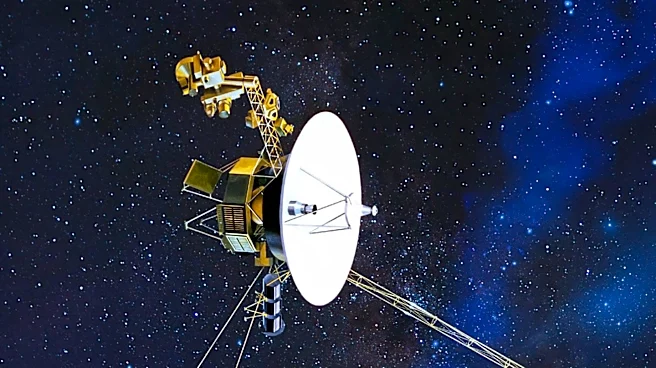
NASA's Voyager 1 spacecraft, the most distant human-made object, has successfully recovered from a communications glitch that caused it to stop transmitting data to Earth for approximately 48 hours between October 18 and 20. The probe resolved the issue
autonomously before engineers at NASA's Jet Propulsion Laboratory (JPL) could send a remote fix. This incident marks the first time the spacecraft has experienced such a self-correction. Engineers are currently investigating the root cause of the communication loss, but initial findings suggest that one group of thrusters went offline, prompting its backups to activate automatically, a programmed response to detected anomalies. Voyager 1, launched in 1977 alongside its twin Voyager 2, continues its mission in interstellar space, nearly one light-day away from Earth, a milestone it is expected to reach on November 18, at a distance of 16.09 billion miles (25.89 billion kilometers).
Why It's Important?
The successful self-recovery of Voyager 1 is a testament to the robust engineering and autonomous capabilities built into these decades-old spacecraft. This event highlights the resilience of deep-space exploration technology, especially as missions extend far beyond their initial design lifetimes. The continued operation of Voyager 1 and Voyager 2 provides invaluable data from interstellar space, offering unique insights into the heliosphere's boundary and the environment beyond our solar system. Such data is crucial for understanding the broader cosmos and the conditions that influence our solar system. The ability of the spacecraft to self-diagnose and correct issues is particularly critical given the immense communication delays, where a command takes nearly a day to reach Voyager 1 and another day for a response to return. This incident underscores the challenges and triumphs of operating spacecraft at extreme distances.
What's Next?
Engineers at JPL will continue to investigate the precise cause of the communication glitch to better understand the spacecraft's behavior and prevent future occurrences. While Voyager 1 has recovered, the team remains vigilant as the spacecraft operates in an increasingly challenging environment. Both Voyager 1 and Voyager 2 are powered by diminishing plutonium sources, requiring engineers to periodically manage power consumption by shutting off instruments or implementing power-saving reconfigurations, such as the recent 'Big Bang' adjustment. These power management strategies aim to extend the operational life of the probes for as long as possible, allowing them to continue transmitting scientific data. The ongoing mission will focus on maximizing data collection while carefully managing the aging spacecraft's resources and responding to any new anomalies that may arise.
Beyond the Headlines
The Voyager mission's longevity and its ability to overcome challenges like this communication glitch have profound implications for future long-duration space missions. The self-correction mechanism demonstrated by Voyager 1 could inform the design of more autonomous spacecraft capable of operating far from Earth with minimal human intervention. This is particularly relevant for missions to distant planets or interstellar probes where real-time control is impractical. Furthermore, the Voyagers serve as a powerful symbol of human ingenuity and our persistent drive to explore the unknown. Their continued journey into interstellar space not only expands our scientific knowledge but also inspires future generations of scientists and engineers to push the boundaries of space exploration, fostering a deeper understanding of our place in the universe.