
What's Happening?
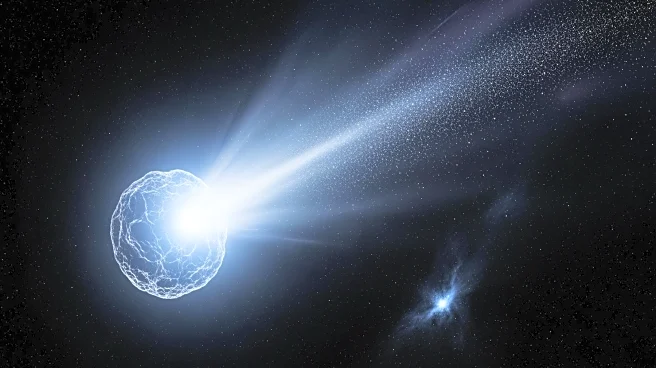
NASA and the European Space Agency (ESA) have released new images of the interstellar comet 3I/ATLAS, showcasing its dramatic activity as it approaches its closest point to Earth on December 19, 2025.
The comet, which originated from outside our Solar System, has been observed by multiple space telescopes, including Hubble and ESA's Juice spacecraft. These observations reveal the comet's twin tails and a rich mix of organic molecules, such as methanol and hydrogen cyanide, which are associated with prebiotic chemistry. Despite its proximity, the comet poses no threat to Earth, remaining at a safe distance of approximately 170 million miles.
Why It's Important?
The study of 3I/ATLAS provides a unique opportunity to understand the composition and behavior of interstellar objects. The presence of organic molecules in the comet's atmosphere suggests that such bodies could carry the building blocks of life across the galaxy. This discovery supports the theory that interstellar comets may play a role in spreading prebiotic materials between star systems. The data collected from these observations will contribute to our understanding of the chemical diversity of comets and their potential to influence the development of life on planets.
What's Next?
As 3I/ATLAS continues its journey through the Solar System, NASA and ESA will maintain their observation efforts to gather as much data as possible before the comet moves out of range. The information collected will be analyzed to refine models of cometary behavior and composition. Future missions may be designed to intercept and study interstellar comets more closely, providing further insights into their origins and potential impact on planetary systems. The ongoing research will also inform strategies for detecting and tracking similar objects in the future.