





What's Happening?
Physicist Stefano Profumo of the University of California, Santa Cruz, has conducted a new mathematical analysis challenging long-held assumptions about dark matter theories. Published in Physical Review D, the study applied a consistent mathematical test,
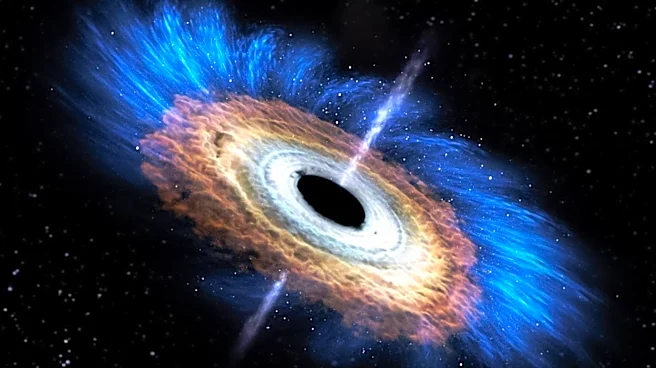
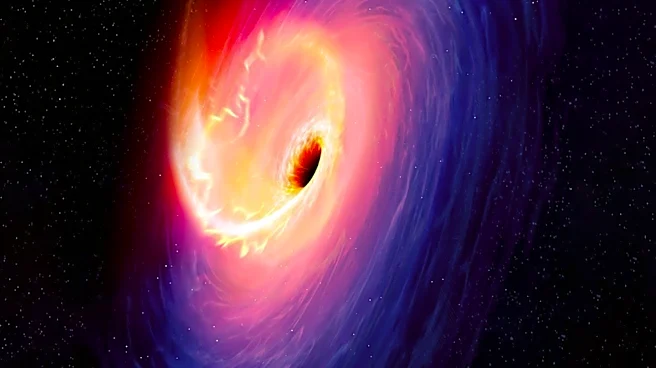
the Barbieri-Giudice measure, to 16 different dark matter theories, including primordial black hole formation scenarios and various particle candidates like Weakly Interacting Massive Particles (WIMPs). The findings indicate that some primordial black hole models are as mathematically stable and 'natural' as the most trusted particle theories, while certain WIMP models are less stable than previously believed. This research directly contradicts the common argument that primordial black holes are 'too fine-tuned' to be viable dark matter candidates. The study assessed how sensitive each theory's prediction for the observed amount of dark matter is to small changes in its input parameters, with less sensitivity indicating greater naturalness.
Why It's Important?
This re-evaluation is significant because it removes a long-standing bias in the search for dark matter. For years, the 'fine-tuning' argument has led many physicists to dismiss primordial black holes in favor of particle candidates. By demonstrating that some black hole models are mathematically as robust as leading particle theories, and some particle theories are more delicate than assumed, the study broadens the scope of viable dark matter research. This could lead to a renewed focus on primordial black holes, potentially redirecting experimental and theoretical efforts in astrophysics and particle physics. The implications extend to funding for research projects, the design of future experiments, and the interpretation of astronomical observations. It encourages a more objective assessment of all dark matter candidates based on rigorous mathematical scrutiny rather than historical assumptions, potentially accelerating the discovery of dark matter's true nature.
What's Next?
The study's findings are expected to prompt a fresh look at various dark matter theories, particularly those involving primordial black holes. Researchers may now dedicate more resources to exploring the observational signatures and theoretical intricacies of these black hole models. Future astronomical observations and particle physics experiments will likely be designed with a more open mind towards a wider range of dark matter candidates. The scientific community will need to engage in further mathematical audits and comparisons, applying similar rigorous standards to other proposed theories. This shift could lead to new collaborations between astrophysicists and particle physicists as they work to refine models and develop new experimental approaches to detect or constrain different dark matter possibilities. The ultimate goal remains to identify the elusive substance that constitutes approximately 85% of the universe's matter.
Beyond the Headlines
The study highlights a deeper issue within scientific methodology: the potential for long-held assumptions to influence research directions. The 'fine-tuning' argument against primordial black holes, while seemingly logical, was not consistently applied across all dark matter theories until this recent mathematical audit. This underscores the importance of periodically re-evaluating foundational arguments with rigorous, standardized methods. It also touches upon the human element in science, where certain theories gain favor or disfavor based on perceived elegance or simplicity, sometimes without exhaustive comparative analysis. The re-opening of the primordial black hole hypothesis could lead to a more holistic understanding of the early universe, black hole formation, and the fundamental constituents of reality, potentially bridging gaps between cosmology and particle physics in unexpected ways. This intellectual shift emphasizes that scientific progress often involves challenging established paradigms through meticulous re-examination of underlying principles.