







What's Happening?
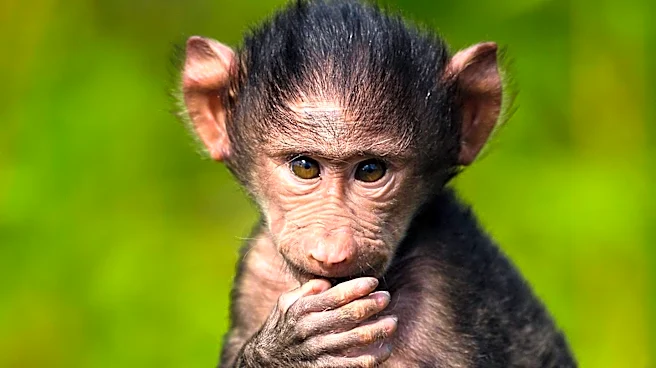
American television personality Ellen DeGeneres has publicly voiced her opposition to the relocation of two wild baboon troops in Cape Town, South Africa. DeGeneres shared a video on her verified Instagram account, drawing international attention to the plight
of the Waterfall and Seaforth baboons, which were captured and moved into a permanent enclosure at Kogelfontein, near Scarborough. She questioned the long-term implications of confining the animals and expressed concerns about the use of sterilization as part of the management program, suggesting it could lead to the disappearance of the troops. DeGeneres also highlighted claims that alternative solutions, such as a privately funded baboon-proof fence, were proposed but rejected by the City of Cape Town. Her intervention comes amidst ongoing protests from Cape Town residents, animal welfare activists, and conservation supporters who are challenging the decision to remove the baboons from their natural habitat and place them in indefinite captivity. The Cape Peninsula Baboon Management Joint Task Team, comprising SANParks, CapeNature, and the City of Cape Town, has defended the relocation, stating that the baboons are adjusting well to their new surroundings and are protected from urban dangers.
Why It's Important?
Ellen DeGeneres's involvement significantly amplifies the visibility of the baboon relocation issue, bringing it to a global audience through her extensive social media following. This international attention can exert pressure on local authorities in Cape Town to reconsider their baboon management strategies and increase scrutiny on wildlife conservation practices. For animal welfare organizations, celebrity endorsements like DeGeneres's are crucial for fundraising and mobilizing public support for their causes. The controversy also highlights the complex challenges of human-wildlife conflict in rapidly urbanizing areas, raising fundamental questions about ethical approaches to managing such interactions. The debate over permanent confinement versus alternative solutions like baboon-proof fencing could influence future policy decisions regarding wildlife management in similar regions worldwide, potentially setting precedents for how urban development coexists with natural ecosystems. The discussion also touches upon the role of sterilization in wildlife management and its long-term ecological impacts.
What's Next?
The ongoing protests and international attention generated by Ellen DeGeneres's comments are likely to intensify pressure on the Cape Town authorities. Animal welfare organizations and local activists will likely continue their advocacy for the release of the baboons and a re-evaluation of the management program. The City of Cape Town and the Cape Peninsula Baboon Management Joint Task Team may face increased demands for transparency regarding their decision-making process, including the scientific assessments and welfare protocols that led to the relocation. It is possible that further investigations or independent reviews of the baboon management plan could be initiated. The debate may also prompt a broader discussion on sustainable solutions for human-baboon conflict, potentially leading to the exploration of more collaborative approaches involving community members, conservationists, and local government. The long-term welfare of the confined baboons, particularly concerning their social structures and reproductive health, will remain a critical point of contention.
Beyond the Headlines
This situation extends beyond immediate animal welfare concerns, touching upon broader ethical and environmental considerations. The permanent confinement of wild animals, even under the guise of protection, raises questions about the intrinsic value of wildlife freedom and the impact of human encroachment on natural habitats. The rejection of privately funded alternative solutions, such as a baboon-proof fence, suggests potential systemic issues in how urban planning and wildlife management intersect, possibly indicating a preference for more immediate, albeit controversial, solutions over long-term, collaborative ones. This incident could serve as a case study for other regions grappling with similar human-wildlife conflicts, prompting a re-evaluation of conservation ethics and the role of public participation in environmental decision-making. It also underscores the power of celebrity influence in galvanizing public opinion and drawing attention to localized environmental issues on a global scale, potentially shifting the dynamics of conservation advocacy.