



What's Happening?
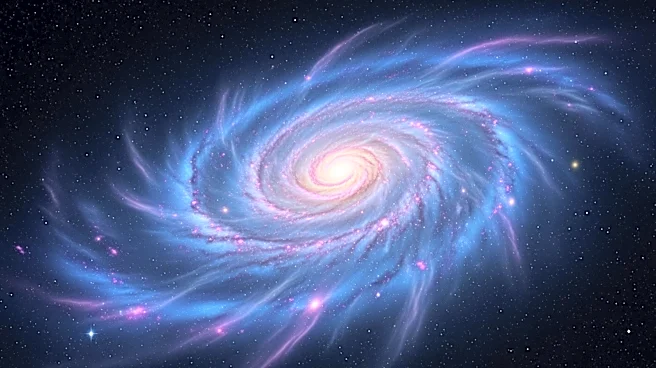
NASA's Hubble Space Telescope has captured images of the lenticular galaxy NGC 1266, located approximately 100 million light-years away in the constellation Eridanus. This galaxy is classified as a post-starburst galaxy, indicating it is transitioning
from a period of intense star formation to a quieter state. Astronomers believe that NGC 1266 underwent a minor merger with another galaxy around 500 million years ago, which led to the formation of new stars and increased the mass of the galaxy's central bulge. This event funneled gas into its supermassive black hole, making it more active and creating an active galactic nucleus (AGN). The increased activity of the black hole has generated powerful winds and jets of gas, depleting the galaxy's reservoir of star-forming gas and suppressing new star formation. Observations reveal a strong outflow of gas and a highly disturbed space between the stars, suggesting that the supermassive black hole may be inhibiting star birth by stripping or ejecting star-forming gas.
Why It's Important?
The study of NGC 1266 provides valuable insights into the complex physical processes that suppress star formation in galaxies. Understanding these processes is crucial for astronomers as it helps them comprehend the evolution of galaxies and the role of supermassive black holes in this evolution. The findings from NGC 1266 can inform broader astrophysical theories about galaxy formation and transformation, particularly the transition from active star-forming galaxies to more passive elliptical galaxies. This research also highlights the significant impact that supermassive black holes can have on their host galaxies, influencing their structure and star formation capabilities.