



What's Happening?
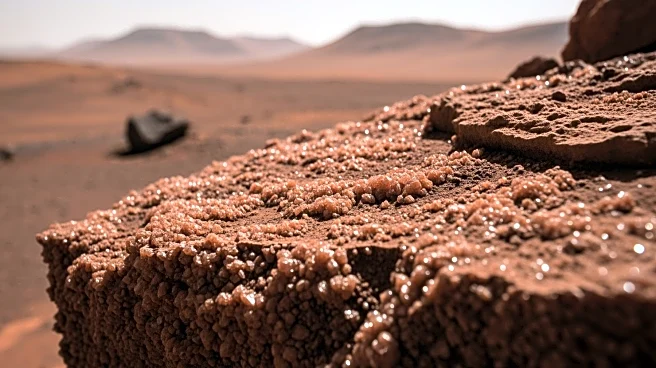
NASA's Curiosity rover has discovered rare minerals in Mars' Gale Crater, indicating the planet's wetter past. The rover, exploring the Vera Rubin Ridge, found high concentrations of hematite, an iron-oxide mineral that forms in water-rich environments.
This discovery suggests that Mars once had conditions more favorable to life. The findings are part of Curiosity's mission to study Mars' ancient environments and understand its transformation from a wet world to its current dry state. The rover's exploration of unique Martian dunes also highlights the planet's distinct surface processes.
Why It's Important?
The discovery of hematite in Gale Crater is crucial for understanding Mars' geological history and its potential to have supported life. These findings provide evidence of past water activity, which is a key factor in assessing the planet's habitability. The research contributes to the broader goal of determining whether life ever existed on Mars. Additionally, studying Martian dunes offers insights into the planet's atmospheric and environmental conditions, which differ significantly from Earth's.
What's Next?
NASA scientists will continue to analyze the mineral deposits to determine their formation processes and the role of water in shaping Mars' surface. The Curiosity rover will further explore the ridge and surrounding areas to gather more data on Mars' past environments. These efforts will help refine models of the planet's climate history and guide future missions aimed at uncovering signs of past life. The findings may also inform the search for habitable conditions on other planets.