



What's Happening?
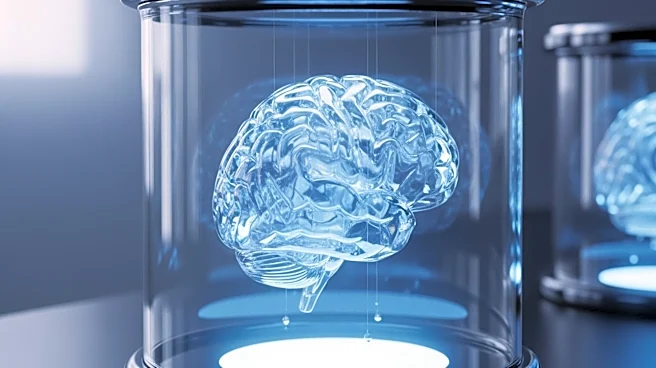
In a groundbreaking study, scientists have successfully revived mouse brain tissue that was frozen to minus 196 degrees Celsius, demonstrating the tissue's resilience to extreme cold. This research, published in the Proceedings of the National Academy
of Sciences, involved vitrification, a process where water is used to cool the tissue rapidly, halting molecular movement. The study, led by Alexander German, MD, at Germany's University Hospital Erlangen, found that the hippocampal tissue of mice, responsible for memory and learning, maintained structural integrity and functional neurons after rewarming. This advancement suggests potential applications in human hibernation, a concept often explored in science fiction but now gaining scientific traction.
Why It's Important?
The ability to preserve and revive brain tissue at cryogenic temperatures could revolutionize fields such as space travel and organ transplantation. For space exploration, inducing a hibernation-like state in humans could make long-duration missions feasible by reducing the need for resources like food and water. Additionally, the techniques developed could enhance organ preservation for transplants, potentially saving lives. However, significant challenges remain, including scaling the process for human application and ensuring safety. The research also opens ethical discussions about the implications of human hibernation and its potential uses beyond space travel.
What's Next?
Future research will focus on overcoming the technical challenges of applying vitrification to larger and more complex human tissues. This includes developing better cooling and rewarming methods and validating these techniques in larger animal models. The study's lead author, Alexander German, highlights the need for sustained research funding, drawing parallels to the extensive investment required for HIV research. Meanwhile, a spinoff company, Hiber, aims to advance cryopreservation techniques for human neural tissue and other organs, potentially leading to breakthroughs in medical and space travel applications.
Beyond the Headlines
The study raises broader questions about the ethical and practical implications of human hibernation. While the potential benefits for space travel are significant, there are concerns about the long-term effects on human health and the prioritization of research funding. Additionally, the concept of human hibernation challenges our understanding of life and consciousness, prompting discussions about the moral considerations of suspending human biological processes. As research progresses, these ethical dimensions will need to be addressed alongside the scientific and technical challenges.