





What's Happening?
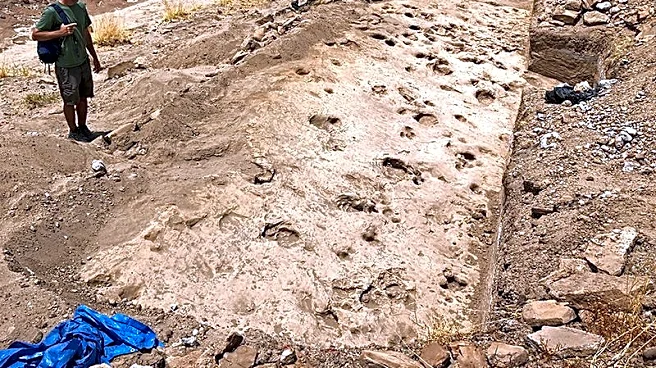
Scientists have updated the understanding of 'Nutcracker Man', an extinct hominin known as Paranthropus boisei, through the analysis of fossil footprints found in Kenya. These footprints, dating back approximately 1.43 million years, suggest that P. boisei was
taller and heavier than previously thought, with males potentially reaching up to 6 feet in height and weighing around 165 pounds. The footprints, discovered at the Koobi Fora Formation, indicate that a group of eight individuals traveled together, hinting at complex social structures. This new evidence challenges earlier estimates based on skeletal remains and provides insights into the behavior and environment of P. boisei.
Why It's Important?
The findings offer a more nuanced understanding of P. boisei, suggesting that this species had a more human-like stature and social organization than previously believed. This challenges existing perceptions of early hominin species and their evolutionary paths. The research highlights the importance of fossil footprints in providing both anatomical and behavioral insights, which can reshape our understanding of human evolution. By revealing the coexistence of P. boisei with Homo erectus, the study also underscores the diversity and complexity of early human relatives, offering a broader perspective on the evolutionary history of hominins.
What's Next?
Further analysis of the P. boisei footprints could provide additional insights into their lifestyle and social behavior. Researchers may continue to explore other fossilized footprints to compare with those of P. boisei, potentially uncovering more about the interactions between different hominin species. This research could lead to a reevaluation of the evolutionary timeline and the development of new hypotheses about the social structures and environmental adaptations of early human ancestors.