
What's Happening?
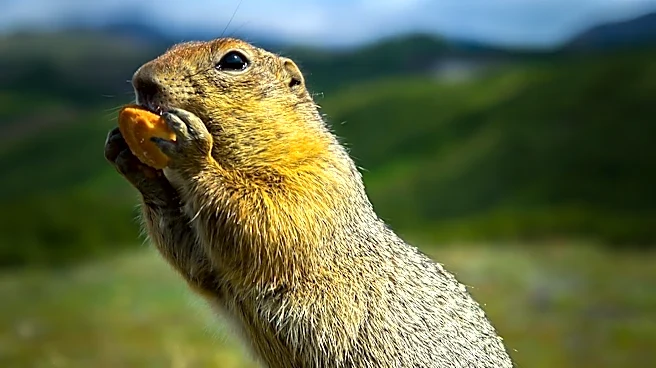
A study conducted by Jaclyn R. Aliperti and colleagues at the University of California, Davis, examines the spatial organization of golden-mantled ground squirrels, a species traditionally considered asocial. The research, published in the Journal of Mammalogy,
found that kinship plays a significant role in the spatial organization of these squirrels. The study observed that related females shared space more than unrelated ones, particularly at higher population densities. This suggests a facultative transition from asociality to forming single-family kin clusters, challenging previous assumptions about the species' solitary nature.
Why It's Important?
The findings of this study have implications for understanding the evolution of social behavior in mammals. By demonstrating that kinship can influence spatial organization even in asocial species, the research suggests that social structures may be more flexible and context-dependent than previously thought. This could impact conservation strategies and ecological studies, as it highlights the importance of considering social dynamics and environmental conditions in wildlife management. The study also contributes to broader discussions on the role of kinship in the development of sociality across species.
What's Next?
Future research may explore the mechanisms behind the observed kinship effects and how they influence reproductive success and survival. Additionally, studies could investigate whether similar patterns occur in other asocial species, potentially leading to a reevaluation of social classifications in mammals. Understanding these dynamics could inform conservation efforts, particularly in managing populations under changing environmental conditions.