


What's Happening?
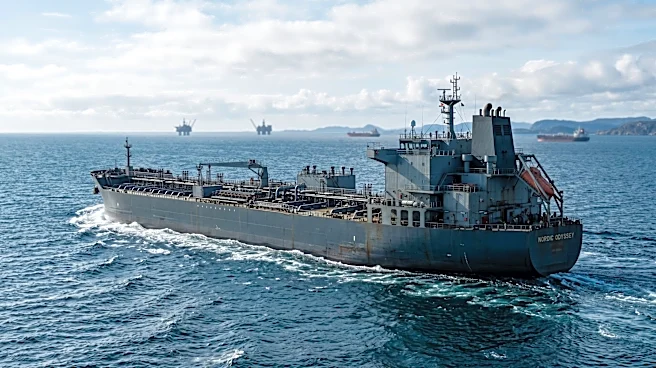
DNV has issued a Statement of Feasibility for Aker BP's and Hoegh Evi’s concept to inject CO2 directly from shuttle carriers into subsea wells for permanent storage at the Atlas project on the Norwegian Continental Shelf (NCS). This concept aims to inject up
to 6 million tonnes of CO2 annually in its initial phase, with a potential total storage capacity of 150 million tonnes. Aker BP is targeting first injection around 2031, with operations planned for over 25 years. The marine-based approach, which avoids new onshore facilities, cross-border pipelines, and permanent offshore structures, is designed to be a scalable and flexible route to storage. DNV's assessment covered the offshore infrastructure for CO2 transfer and injection, identifying main technical challenges as manageable at this development stage.
Why It's Important?
This DNV assessment is a crucial step in advancing carbon capture, utilization, and storage (CCUS) technologies, particularly for hard-to-abate industrial emissions in Europe. The concept offers a flexible and scalable solution for transporting and storing CO2, which is vital for achieving decarbonization goals. By enabling direct injection from ships, it bypasses the need for extensive onshore infrastructure, potentially accelerating the deployment of CCUS projects. The Atlas project, which has received EUR 223 million from the EU Innovation Fund, highlights the international commitment to developing such solutions. The ability to aggregate CO2 from multiple sources and deliver it directly to offshore storage could make CCUS accessible to a wider range of industrial emitters, significantly contributing to climate change mitigation efforts.
What's Next?
Following DNV's Statement of Feasibility, Aker BP and Hoegh Evi will continue to mature the Atlas project towards a Final Investment Decision (FID) in 2028. This will involve further verification and maturation work to address technical challenges as the project progresses. The concept is intended to connect multiple European industrial clusters to high-quality offshore storage on the Norwegian Continental Shelf. Subject to future investment decisions, operations are planned to commence in 2031. The marine-based direct-injection concept is also being evaluated for Aker BP’s other CO2 storage license on the NCS, EXL005 Poseidon, indicating potential for broader application.
Beyond the Headlines
The development of ship-based CO2 transport and offshore injection represents a significant innovation in the global effort to combat climate change. This approach addresses several critical challenges in CCUS, including the high cost and logistical complexities associated with traditional pipeline infrastructure. By offering a flexible and scalable solution, it could unlock new opportunities for industries to decarbonize, particularly those located far from existing pipeline networks or with smaller emission profiles. The project's inclusion in the European Commission's list of Projects of Common Interest and Projects of Mutual Interest underscores its strategic importance for European energy security and climate policy. This technology could set a precedent for future carbon management strategies worldwide, fostering a more integrated and efficient approach to CO2 capture, transport, and permanent storage.