



What's Happening?
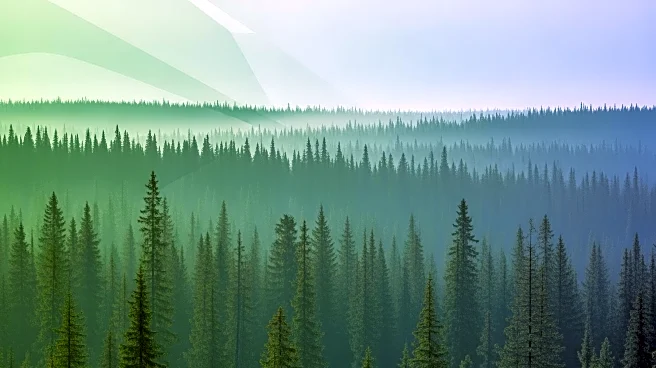
NASA's Goddard Space Flight Center has confirmed that boreal forests, the world's largest terrestrial biome, are shifting northward. This conclusion comes from a study conducted by Feng et al., which analyzed data from 1985 to 2020 using Landsat imagery.
The research, published in Biogeosciences, utilized machine learning to process over 224,000 scenes from Landsats 4, 5, 7, and 8, creating detailed maps of tree cover. The study found that boreal forests have expanded by 0.844 million km², a 12% increase, and shifted northward by 0.29° mean latitude. This movement is concentrated between 64-68°N. The study also highlights the role of young boreal forests as carbon sinks, with the potential to sequester significant amounts of carbon if allowed to mature.
Why It's Important?
The northward shift of boreal forests is a significant indicator of climate change, as these forests are warming faster than any other forest type. The expansion and movement of these forests could have profound implications for global carbon cycles, as young boreal forests can act as carbon sinks. This shift may also affect biodiversity, as species adapted to specific climates may struggle to survive in new conditions. The study underscores the importance of long-term satellite data in understanding ecological changes and informs policymakers and environmentalists about the potential impacts of climate change on terrestrial ecosystems.
What's Next?
Future research will likely focus on monitoring the continued movement of boreal forests and their role in carbon sequestration. Policymakers may need to consider strategies for managing these forests to maximize their carbon sink potential. Additionally, there may be increased interest in studying the impacts of this shift on local wildlife and plant species, as well as the broader implications for global climate patterns. Continued advancements in satellite technology and data analysis will be crucial in tracking these changes over time.
Beyond the Headlines
The movement of boreal forests northward raises ethical and environmental questions about land use and conservation. As these forests expand into new territories, there may be conflicts over land rights and resource management. The potential for increased carbon sequestration presents an opportunity for climate mitigation, but it also requires careful management to ensure that these ecosystems are preserved and not exploited. This development highlights the interconnectedness of global ecosystems and the need for international cooperation in addressing climate change.