





What's Happening?
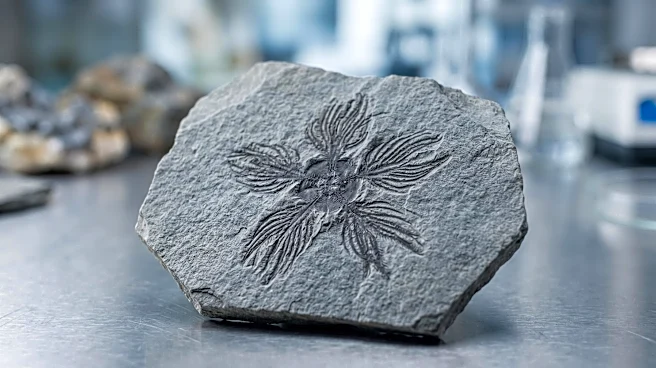
Researchers have discovered four 518-million-year-old fossils in southern China, named Yujingia glutenotunica, which are challenging long-held theories about the evolution of starfish and their relatives. These fingernail-sized fossils, found in the Maotianshan
Shales in Yunnan province, preserve soft tissue and feature feathery feeding arms. This discovery suggests that the common ancestor of Ambulacraria—the group including starfish, sea urchins, and acorn worms—was a tentacle-feeding animal anchored to the seabed, rather than a burrowing, worm-like creature that filtered food through its throat, as previously hypothesized. The complexity of Yujingia's feeding structures, including alternating pinnules and a ciliated groove, is unusual for a Cambrian animal and resembles modern sea lilies. The team, led by Kaiyue He of Northwest University in Xi’an, along with colleagues from the China University of Geosciences in Beijing and two German museums, analyzed 505 anatomical features across 100 species to place Yujingia just outside the group of all living ambulacrarians, making it the closest fossil to their shared ancestor described to date.
Why It's Important?
This discovery significantly alters the understanding of early animal evolution during the Cambrian Explosion, a period of rapid diversification of animal forms around 541 million years ago. By presenting evidence that the ancestral form of starfish and their relatives was a sessile, tentacle-feeding organism, it reconfigures the evolutionary tree of a major animal phylum. This shift in understanding implies that complex features like the starfish's fivefold symmetry and regenerative capabilities evolved later, building upon an already specialized feeding mechanism. The findings highlight the importance of exceptional fossil deposits, like the Maotianshan Shales, which preserve soft tissues and provide crucial insights into the morphology and lifestyles of ancient organisms that would otherwise be lost. This research contributes to a more accurate and nuanced picture of how diverse body plans emerged and adapted in early marine ecosystems, influencing how scientists interpret the evolutionary pathways of other animal groups.
What's Next?
Future research will likely focus on further analyzing the limited number of Yujingia specimens to resolve remaining uncertainties, such as the exact arrangement of its crown and the nature of certain internal structures. Scientists will also continue to explore other Cambrian fossil sites, particularly those known for soft-tissue preservation, to uncover more transitional forms that can shed light on the evolutionary history of Ambulacraria and other early animal groups. The questions raised by this discovery, such as how ambulacrarians lost segmented musculature or why some modern relatives lost their tentacles, will guide new investigations. This ongoing exploration of ancient life forms will continue to refine our understanding of the Cambrian Explosion and the fundamental processes that shaped animal diversity on Earth.
Beyond the Headlines
The reinterpretation of the starfish ancestor underscores a broader theme in paleontology: that scientific understanding is constantly evolving as new evidence emerges. The initial hypothesis of a burrowing worm-like ancestor was a reasonable inference based on available data, but the discovery of Yujingia demonstrates how a single, well-preserved fossil can fundamentally challenge and reshape established evolutionary narratives. This highlights the dynamic nature of scientific inquiry, where even long-held assumptions are subject to revision. Furthermore, the study emphasizes the critical role of fossil sites that preserve soft-bodied organisms, as these rare windows into ancient ecosystems provide invaluable details about the anatomy and ecology of early life that hard-part fossils cannot. The ongoing discoveries from sites like the Chengjiang beds continue to reveal the unexpected complexity and diversity of life during the Cambrian period, pushing the boundaries of our knowledge about life's origins and early diversification.