
What's Happening?
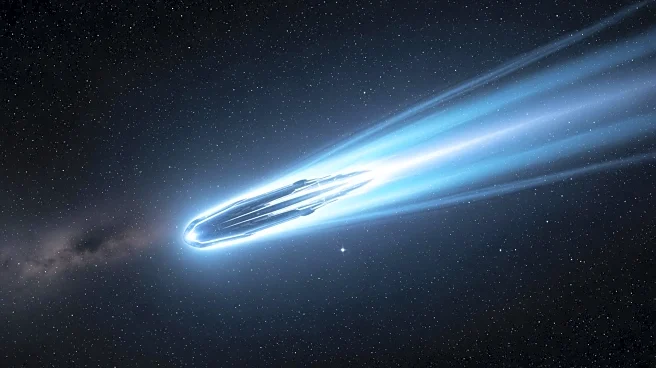
Astronomers are closely observing 3I/ATLAS, an interstellar object believed to be a comet, as it makes its closest approach to Earth. The object is expected to pass within nearly twice the average distance
between Earth and the Sun. Harvard astronomer Avi Loeb has highlighted several anomalies associated with 3I/ATLAS, including its trajectory, which aligns almost exactly with the solar system's planets. The object also exhibits an unusually high concentration of carbon dioxide ice and gas, and a 'Sunward jet' that Loeb suggests could be a beam designed to mitigate risks from micrometeorites. Recent observations by a team in Spain detected a wobbling high-altitude jet in the comet, adding to the mystery surrounding its behavior.
Why It's Important?
The study of 3I/ATLAS offers a rare opportunity for astronomers to gather data on an interstellar object, potentially enhancing our understanding of such phenomena. The anomalies observed could provide insights into the nature of interstellar comets and their interactions with solar systems. If the object is indeed a comet, it could help refine models of cometary behavior and composition. Alternatively, if the anomalies suggest an artificial origin, it could have profound implications for our understanding of extraterrestrial technology and the potential for intelligent life beyond Earth.
What's Next?
Astronomers plan to conduct further spectroscopic observations to analyze the material within 3I/ATLAS's anti-tail. These observations may clarify the nature of the anomalies and provide more information about the object's composition and behavior. The scientific community is likely to continue debating the object's origin, with some considering the possibility of it being an alien spacecraft. The findings could influence future research priorities and funding for the study of interstellar objects.
Beyond the Headlines
The anomalies associated with 3I/ATLAS raise questions about the processes that govern the behavior of interstellar objects. If the object is natural, it could challenge existing theories about comet formation and behavior. If artificial, it could suggest the presence of advanced extraterrestrial technology. The study of 3I/ATLAS may also influence public interest in space exploration and the search for extraterrestrial life, potentially impacting cultural perceptions of humanity's place in the universe.