
What's Happening?
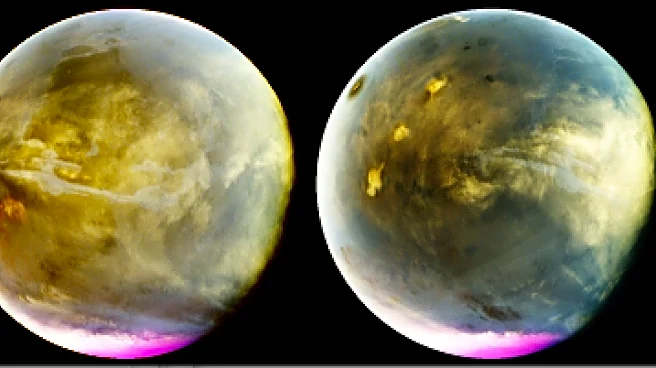
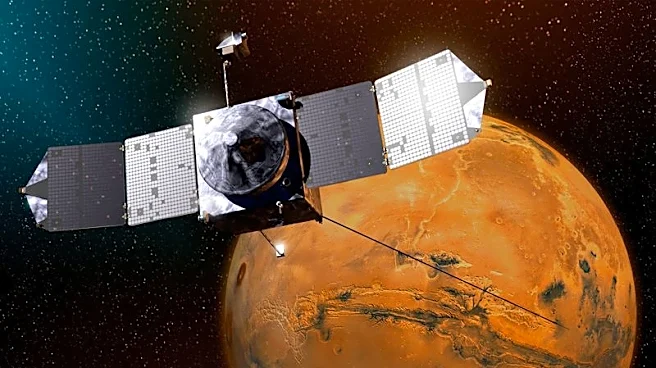
NASA has officially declared the Mars Atmosphere and Volatile EvolutioN (MAVEN) satellite mission over after months of unsuccessful attempts to reestablish contact. MAVEN, which launched in November 2013,
was instrumental in studying Mars' atmosphere and its evolution. The last communication from MAVEN was received on December 6, 2025, before it went behind Mars and subsequently lost power due to an uncontrollable spin. Despite efforts to regain contact, the satellite remains unresponsive. MAVEN's mission, originally planned for one year, was extended for over a decade, contributing significantly to Mars research. The loss leaves NASA with two operational probes in Mars orbit: Mars Odyssey and Mars Reconnaissance Orbiter.
Why It's Important?
The end of the MAVEN mission marks a significant moment in Mars exploration, as the satellite provided critical data on the Martian atmosphere and its interaction with solar winds. This information has been vital for understanding Mars' climate history and potential habitability. The loss of MAVEN reduces NASA's capacity to relay communications for Mars surface missions, although other satellites continue to serve this function. The mission's conclusion underscores the challenges of long-term space exploration and the need for robust systems to withstand harsh space environments. The data collected by MAVEN will continue to be valuable for future research and exploration efforts.
What's Next?
NASA plans to hold a press briefing to discuss the end of the MAVEN mission and the findings of the anomaly review board investigating the cause of the satellite's failure. The agency will continue to analyze the data collected by MAVEN to extract further insights into Mars' atmospheric conditions. Meanwhile, NASA's remaining Mars orbiters will continue their operations, and future missions may be planned to fill the gap left by MAVEN. The ongoing investigation into the satellite's failure may also inform the design and operation of future space missions.