


What's Happening?
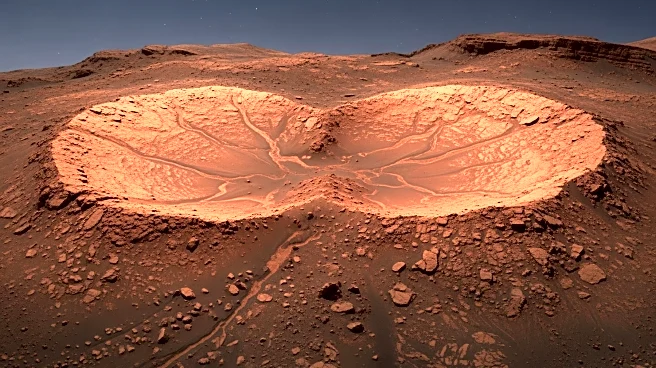
The European Space Agency (ESA) has released new images of a unique impact crater on Mars, dubbed the 'cosmic butterfly,' located in the Idaeus Fossae region. This crater, formed by an asteroid impact at a low angle, spans approximately 12.4 miles by 9.3
miles. The images, generated using data from the Mars Express orbiter, reveal the crater's distinctive 'wings,' created by the uneven distribution of debris during the impact. The crater's floor, described as walnut-like, contrasts with the smoother wings, suggesting the presence of fluidized material, likely due to water released from melted Martian ice during the impact.
Why It's Important?
The discovery of the 'cosmic butterfly' crater is significant for understanding Mars' geological history and the role of water in shaping its surface. The presence of fluidized material indicates that water, possibly from ice beneath the surface, was involved in the crater's formation. This finding contributes to the broader understanding of Mars' past climate and the potential for ancient water reservoirs. Such insights are crucial for future Mars exploration missions, as they may guide the search for signs of past life and inform the selection of landing sites for rovers and human missions.
What's Next?
Further analysis of the 'cosmic butterfly' crater could provide more detailed information about the size and speed of the impacting asteroid, as well as the conditions on Mars at the time of the impact. Scientists may also investigate the possibility of finding fragments of the asteroid within the crater. Continued exploration by the Mars Express orbiter and other missions will enhance our understanding of Mars' geological features and the planet's potential to support life in the past.
Beyond the Headlines
The 'cosmic butterfly' crater is part of a broader pattern of animal-like geological formations on Mars, which have intrigued scientists and the public alike. These formations, including turtle-like rocks and spider-like cracks, highlight the diverse and dynamic processes that have shaped the Martian surface. Studying these features not only provides insights into Mars' history but also challenges scientists to interpret geological data in new and creative ways.