








What's Happening?
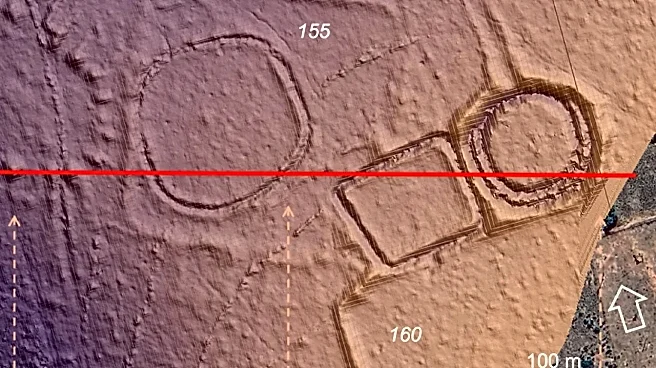
Recent LiDAR studies have uncovered hundreds of ancient earthworks in the Amazon rainforest, attributed to the Aquiry civilization, which emerged approximately 2,500 years ago in Brazil. These findings include complex geometric structures, roads, and
embankments, suggesting a densely populated region that may have supported up to 3 million people at its peak. The use of advanced laser scanning technology has allowed scientists to penetrate the dense canopy of the rainforest, revealing these hidden geoglyphs and offering new insights into the lives and societal structures of this mysterious civilization.
Why It's Important?
The discovery of these ancient earthworks is significant as it challenges previous assumptions about the Amazon rainforest being a sparsely populated wilderness before European contact. The findings suggest that the region was home to complex societies with advanced engineering capabilities. This revelation could reshape our understanding of pre-Columbian history in the Americas and highlight the importance of preserving the Amazon rainforest, not only for its ecological value but also for its cultural and historical significance. The study underscores the potential of modern technology to uncover hidden aspects of human history, offering a new perspective on the capabilities and achievements of ancient civilizations.
What's Next?
Further research and exploration are likely to follow, as archaeologists and historians seek to understand more about the Aquiry civilization and its impact on the region. This could involve more detailed mapping of the earthworks and possibly excavations to uncover artifacts that could provide additional insights into the daily lives, trade, and cultural practices of the people who built these structures. The findings may also prompt a reevaluation of conservation strategies in the Amazon, emphasizing the need to protect both its natural and archaeological resources.
Beyond the Headlines
The discovery of these geoglyphs raises questions about the sustainability practices of ancient civilizations and how they managed to thrive in such a challenging environment. It also highlights the potential for undiscovered archaeological sites in other remote regions of the world, suggesting that our understanding of ancient human history is still incomplete. The use of LiDAR technology in archaeology could lead to more discoveries, offering a non-invasive way to explore and document historical sites without disturbing the environment.