






What's Happening?
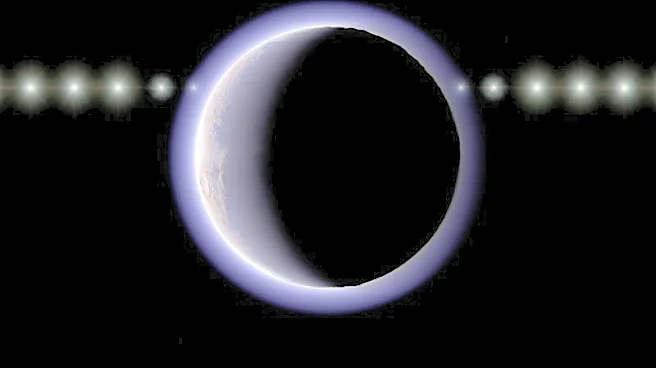
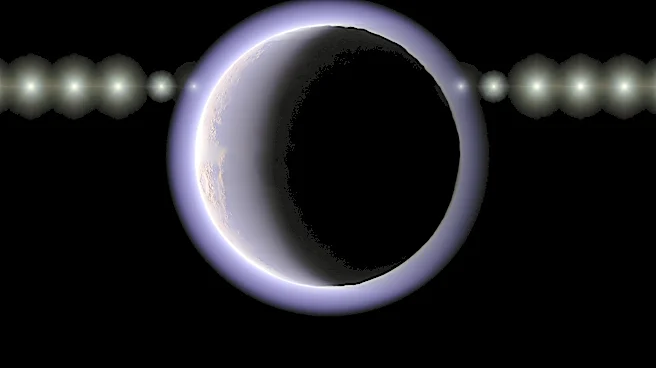
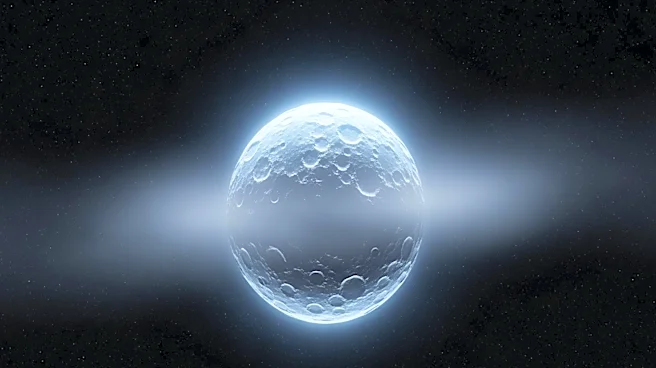
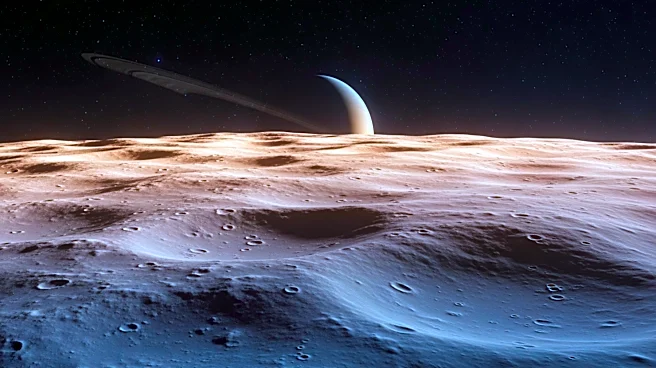
A trans-Neptunian object, designated (612533) 2002 XV93, has developed a mysterious atmosphere, baffling scientists. This object, located in the Kuiper Belt beyond Neptune, is significantly smaller than Pluto, measuring about 310 miles across. Unlike
Pluto, which retains a thin atmosphere when near the sun, no other Kuiper Belt object has been found with an exosphere. Observations by Japanese astronomers during a stellar occultation revealed the presence of an atmosphere, contradicting expectations. The atmosphere is extremely thin, with a surface pressure 5 to 10 million times less than Earth's. The composition of the atmosphere remains uncertain, as previous observations found no evidence of the ices typically responsible for such atmospheres. Scientists propose two theories: a recent impact or cryovolcanism, but both have challenges. This discovery challenges the traditional understanding of atmospheric formation on small celestial bodies.
Why It's Important?
The discovery of an atmosphere on (612533) 2002 XV93 is significant as it challenges existing theories about atmospheric formation on small celestial bodies. Traditionally, it was believed that only larger planets could sustain atmospheres. This finding suggests that even smaller objects in the Kuiper Belt might have the potential to develop atmospheres under certain conditions. Understanding the mechanisms behind this phenomenon could provide insights into the processes that govern atmospheric retention and loss in the solar system. Additionally, it raises questions about the potential for similar discoveries on other small bodies, which could have implications for our understanding of the solar system's evolution and the conditions necessary for atmospheric development.
What's Next?
Future research will focus on determining the composition of the atmosphere on (612533) 2002 XV93. The James Webb Space Telescope is expected to play a crucial role in this investigation. Monitoring the atmosphere's density over time will help scientists understand whether it is being replenished or if it is a temporary feature resulting from a recent impact. If the atmosphere's density decreases, it may indicate an impact origin, while a stable density could suggest ongoing outgassing. These findings will contribute to refining models of atmospheric dynamics on small celestial bodies and may lead to a reevaluation of the potential for atmospheres on other trans-Neptunian objects.