




What's Happening?
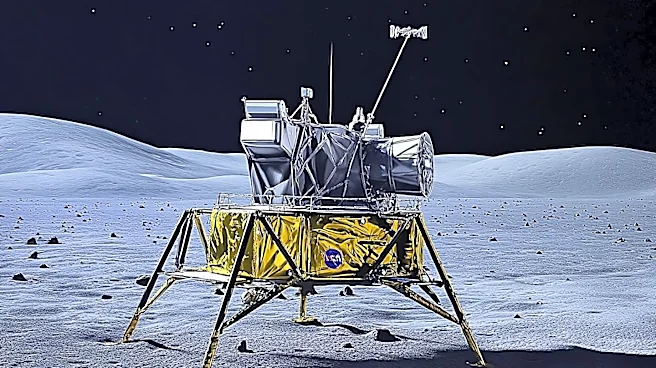
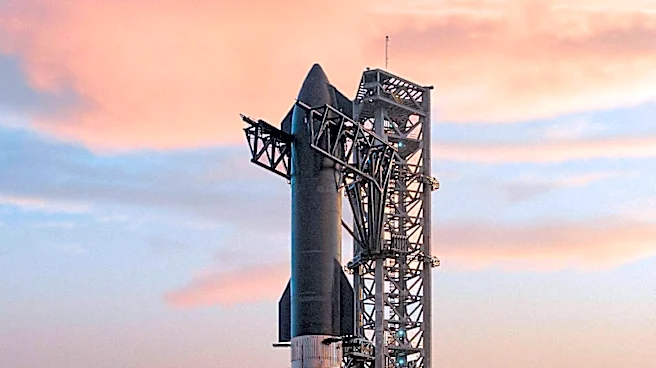
NASA has selected SpaceX to develop the Starship Human Landing System (HLS) for the Artemis program, with the vehicle designed to transport astronauts between lunar orbit and the Moon's surface. The confirmed architecture involves an orbital propellant
storage Starship, which will be supplied by tanker Starships. The human-rated Starship will launch to this storage vehicle in Earth orbit, refuel, and then proceed to lunar orbit. Artemis astronauts will launch aboard NASA's Orion capsule on the Space Launch System (SLS) rocket, rendezvous, and dock with Starship HLS in Earth orbit before heading to the Moon. While SpaceX claims on-orbit refilling can enable Starship to deliver up to 100 tons to the lunar surface, the exact number of launches required to send NASA astronauts to the Moon remains unconfirmed by official sources.
Why It's Important?
The reliance on orbital refueling for Starship HLS is a fundamental shift in lunar mission architecture, moving from a single-launch approach like Apollo to a multi-launch, reusable system. This strategy aims to enable heavier payloads and more frequent lunar missions, but it introduces significant operational complexity and dependencies. The unconfirmed launch count creates uncertainty for program planning, cost estimations, and risk assessment. A higher number of tanker flights would necessitate more Super Heavy boosters, Raptor engines, and pad turnarounds, impacting the overall cost, schedule, and logistical demands of the Artemis program. The success of this refueling strategy is critical for the feasibility of NASA's ambitious lunar exploration goals and the long-term sustainability of human presence on the Moon.
What's Next?
NASA and SpaceX have publicly described plans for an orbital refueling demonstration involving a depot and tanker Starships. The outcomes of these demonstrations will be crucial in determining the actual transfer efficiency, boil-off rates, and overall feasibility of the refueling process. Until these tests are completed and official figures are published, any precise tally of required launches, such as the frequently cited six to eight launches attributed to Elon Musk, remains an estimate. The re-sequencing of Artemis missions, with SpaceX supporting a second human-landing demonstration under Artemis IV, suggests that early tests of docking and refueling steps will precede crewed landings, allowing for adjustments based on real-world performance.
Beyond the Headlines
The complexity of orbital refueling extends beyond mere plumbing, involving challenges such as precise rendezvous and docking of large vehicles, maintaining cryogenic propellant temperatures for extended periods in space, and efficient liquid transfer in microgravity. Each of these factors can influence the number of tanker flights required. The trade-off between the cost-effectiveness of reusability and the operational complexity of multiple launches and in-orbit operations is a key consideration. The program's dependence on one company's launch tempo also exposes it to potential disruptions. The aerospace market and investors will closely watch the demonstration results, as a proven orbital refueling capability would significantly lower barriers for various orbital businesses and validate the economic models underpinning Starship's ambitious capabilities.