
What's Happening?
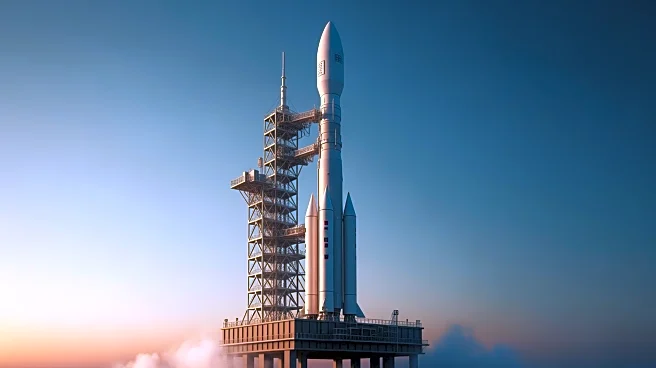
NASA has successfully moved its Artemis II Moon rocket to Launch Pad 39B at the Kennedy Space Center in Florida. This marks a significant step towards the agency's first crewed lunar mission in over 50
years. The Space Launch System (SLS) rocket, along with the Orion crew capsule, completed a slow 12-hour journey from the Vehicle Assembly Building to the launch pad. The next critical phase is the 'wet dress rehearsal,' scheduled for no later than February 2, where the rocket will be loaded with super-cold propellants and undergo a full countdown practice. This test is crucial for ensuring the readiness of the rocket for its mission, which aims to send NASA astronauts Reid Wiseman, Victor Glover, and Christina Koch, along with Canadian astronaut Jeremy Hansen, on a 10-day flight around the Moon and back.
Why It's Important?
The Artemis II mission is a pivotal moment for NASA as it seeks to re-establish a consistent schedule of lunar missions. This mission is not only a demonstration of international cooperation, with the inclusion of a Canadian astronaut, but also a testament to the capabilities of the American workforce. Successfully launching Artemis II will pave the way for future missions that aim to establish a sustainable human presence on the Moon, which is a critical step towards the long-term goal of sending humans to Mars. The mission's success could also bolster public and governmental support for NASA's lunar exploration initiatives.
What's Next?
Following the wet dress rehearsal, NASA will analyze the data to ensure the rocket's systems are functioning correctly. If any issues arise, such as leaks or software problems, the rocket may need to be rolled back to the Vehicle Assembly Building for further work. NASA has identified additional launch windows in March and April, providing flexibility in case of delays. The outcome of the wet dress rehearsal will be a determining factor in setting the final launch date. The mission's success will be closely watched by international partners and could influence future collaborations in space exploration.