




What's Happening?
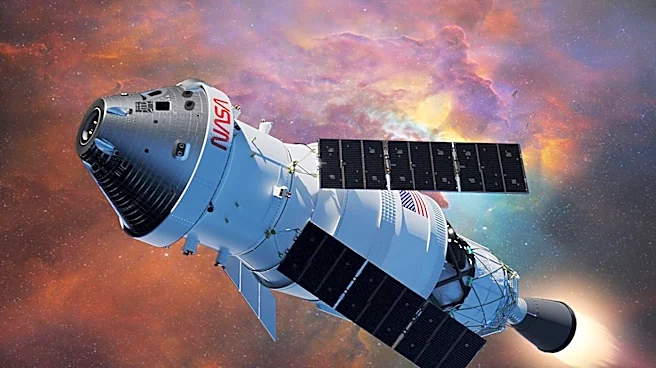
The recent Artemis II launch, which sent four astronauts around the Moon, caused measurable disturbances in the Earth's ionosphere, extending approximately 3,100 miles (5,000 kilometers) across North America. Researchers, utilizing existing ground-based
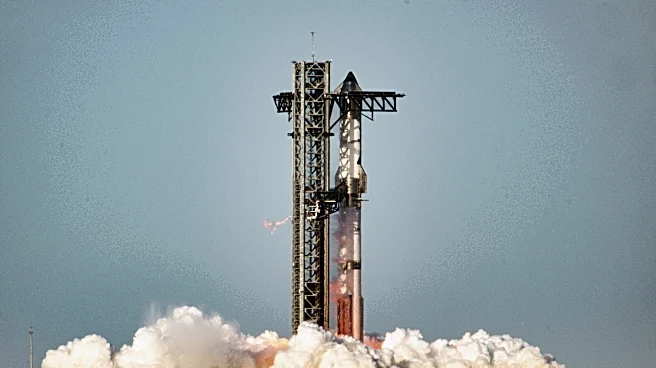
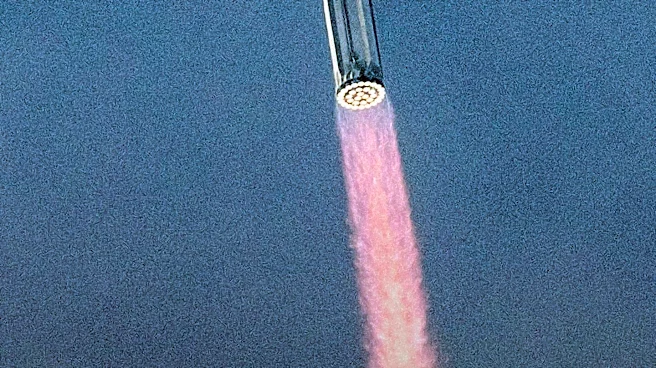
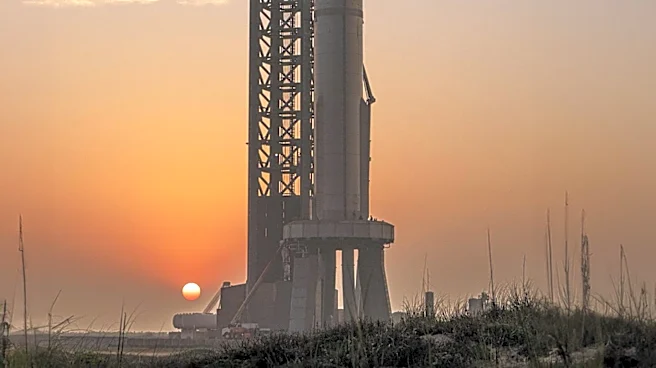
GPS stations, detected changes in electron concentrations that were equivalent to positioning errors of several meters. The Space Launch System (SLS) rocket produced two distinct disturbances: one from its 212-foot (65-meter) core stage and a more prominent one from two later upper-stage thruster burns. This effect was reported to be up to 10 times more intense than disturbances observed after SpaceX Starship test launches, despite Starship having roughly twice the liftoff thrust of the SLS. The term 'hole' in the atmosphere, used in some headlines, refers to temporary regions of depleted electrons, which eventually refill, rather than a permanent breach or broad GPS outage.
Why It's Important?
This discovery highlights the significant impact large rocket launches can have on the Earth's upper atmosphere and, consequently, on critical navigation systems. While a few meters of error might be negligible for a phone's navigation, it poses a substantial challenge for applications requiring high precision, such as autonomous driving, precision agriculture, surveying, and drone control. The widespread nature of the disturbance, spanning a continent-scale area, means that a large number of GPS receivers could be affected. For the scientific community, particularly those involved in geoscience, these launch-driven ionospheric events introduce noise into data collected by ground stations designed to measure minute ground movements, potentially complicating research. This event underscores the need for improved understanding and mitigation strategies as space launch cadences increase.
What's Next?
Researchers are expected to closely monitor future SLS flights to determine if the Artemis II ionospheric footprint was typical or an anomaly. This will involve planning observations in advance rather than relying solely on archived data. The findings will likely prompt regulators and navigation engineers to consider the cumulative effects of a busy launch calendar on the ionosphere, especially with the increasing frequency of heavy vehicle launches like Starship. This could lead to discussions about incorporating atmospheric effects into launch oversight. For the navigation hardware industry, this event strengthens the case for multi-band GNSS chips and sensor fusion in devices like phones, cars, and drones, as these technologies are more resilient to ionospheric shifts. Satellite-navigation suppliers and device manufacturers may use this real-world example to advocate for higher-end receivers and correction services.
Beyond the Headlines
The implications extend beyond immediate GPS accuracy to broader considerations of space traffic management and environmental impact. As humanity ventures further into space with more frequent and powerful launches, understanding and mitigating atmospheric disturbances becomes crucial. This event could spur innovation in atmospheric modeling and prediction, leading to more sophisticated ways to forecast and potentially counteract such effects. Ethically, it raises questions about the long-term environmental consequences of increased space activity on Earth's atmosphere, even if the current effects are temporary. Culturally, it reinforces the idea that space exploration, while awe-inspiring, is not without its terrestrial consequences, prompting a more holistic view of our interaction with the space environment. This incident serves as a scientific data point for a future where space launches are a routine occurrence, necessitating a deeper integration of atmospheric science into space mission planning.