





What's Happening?
Cenk Uygur, founder of The Young Turks, has publicly redefined the term 'antisemite,' stating that it now often refers to a 'moral and kind person.' This redefinition emerged during a heated debate surrounding the Israel-Palestine conflict, specifically
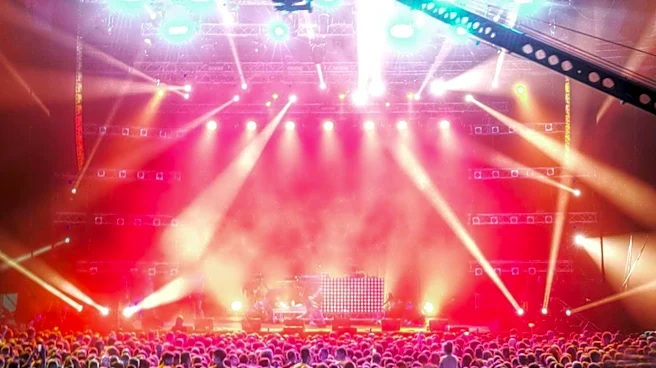
after musician Macklemore's 'Free Palestine' statement at a concert. Uygur claims that groups he labels as 'Zionist thugs,' who he alleges pretend to represent Jewish-Americans, use the term 'antisemite' against individuals who advocate for Palestine. He asserts that demanding that Palestinians not be treated as 'sub-human' is a moral stance, and that those who disagree with what he calls 'fascist beliefs' of these 'Zionist thugs' are unfairly labeled. Uygur's comments suggest that the term is being weaponized to silence criticism of Israel and its policies, rather than to genuinely address hatred towards Jewish people. He further argues that if one believes other people should not be enslaved by Israelis, they are then accused of discriminating against Jews, which he views as a demand for a 'chosen race' status, equating it to fascism.
Why It's Important?
Uygur's redefinition of 'antisemite' is significant because it directly challenges the established understanding of a term used to describe prejudice and discrimination against Jewish people. This move could further polarize discussions around the Israel-Palestine conflict, potentially undermining efforts to combat actual antisemitism by blurring its definition. By framing criticism of Israeli policies as a 'moral and kind' act, and labeling those who disagree as 'Zionist thugs' with 'fascist beliefs,' Uygur contributes to an environment where nuanced discussion is difficult. This could impact public discourse in the U.S., particularly among younger audiences who follow figures like Uygur, by shifting perceptions of what constitutes antisemitism and legitimate criticism. The controversy highlights the ongoing struggle to define and address antisemitism in a way that is both accurate and inclusive, without being used to stifle free speech or legitimate political commentary.
What's Next?
The redefinition of 'antisemite' by Cenk Uygur is likely to continue generating significant debate and backlash, particularly from Jewish organizations and those who adhere to the traditional definition of antisemitism. Social media platforms will likely remain a primary battleground for these discussions, with supporters and detractors of Uygur's stance engaging in further exchanges. This controversy could also influence how media outlets and public figures approach discussions on the Israel-Palestine conflict, potentially leading to more cautious language or, conversely, more provocative statements. The incident may also prompt further examination of the role of public figures in shaping definitions of sensitive terms and the impact of such redefinitions on societal understanding and intergroup relations. It remains to be seen if this redefinition gains wider acceptance or if it is largely dismissed by mainstream discourse.
Beyond the Headlines
The deeper implication of Cenk Uygur's redefinition of 'antisemite' lies in its potential to erode the meaning of critical terms used to identify and combat hate. When definitions of hate speech are manipulated or broadened to include political disagreements, it risks diluting the severity of actual prejudice and making it harder to address genuine instances of antisemitism. This trend is part of a larger cultural and political phenomenon where language itself becomes a battleground, and terms are reappropriated to serve specific ideological agendas. The controversy also touches upon the ethical responsibility of media personalities and influencers in shaping public understanding of complex and sensitive issues. The long-term shift could be a further fragmentation of shared understanding, where different groups operate with entirely different definitions of fundamental concepts, making constructive dialogue and consensus-building increasingly challenging in a polarized society.