




What's Happening?
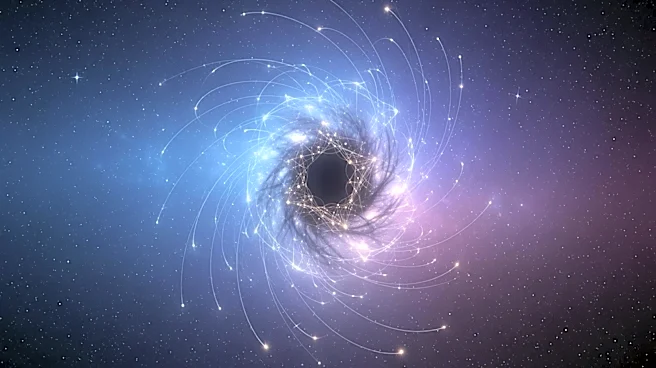
A new theoretical study suggests that black holes may not fully evaporate, challenging Stephen Hawking's theory and the information loss paradox. The study, involving Richard Pinčák from the Slovak Academy of Sciences, proposes that black holes leave
behind stable remnants that retain all consumed information. This theory requires the universe to have three additional hidden dimensions, making it seven-dimensional. These dimensions create a repulsive force that prevents black holes from completely evaporating. The study offers a novel approach to resolving one of physics' deepest puzzles by linking black holes to the geometry of extra dimensions.
Why It's Important?
This study has significant implications for theoretical physics, particularly in understanding quantum mechanics and gravity. Resolving the information loss paradox could address a major issue in physics. The theory also suggests a connection between black holes and particle physics, potentially impacting our understanding of the Higgs mechanism and the electroweak scale. If proven, this theory could reshape our understanding of the universe's structure and black hole behavior, influencing future research in quantum gravity and cosmology.
What's Next?
Testing this theory is challenging due to the high energy scales involved, beyond current particle accelerator capabilities. However, the study makes concrete predictions that could be tested indirectly. Future gamma-ray telescopes or gravitational wave detectors might provide evidence for stable black hole remnants. Researchers aim to further connect their framework to fundamental theories like M-theory and explore how information is stored in these remnants. If validated, this theory could lead to a paradigm shift in our understanding of black holes and the universe.