





What's Happening?
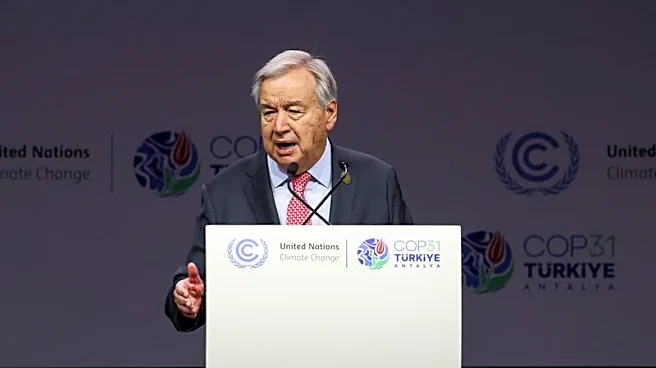
Fatih Birol, the executive director of the International Energy Agency (IEA), announced at the COP31 UN climate summit in Turkey that the world has transitioned from the age of coal, oil, and gas into the 'age of electricity.' Birol highlighted that electricity generation
is projected to more than double in the next decade compared to the last, with an expected 12,000 gigawatts to be added globally, up from 5,000 gigawatts in the previous decade. This shift is driven by countries seeking to secure energy supplies amidst fossil fuel price volatility and supply shocks. The electrification trend is evident in the transport sector, with electric car sales outside China increasing by 60% in the last nine months. The growth of AI data centers and the rising demand for air conditioning due to more intense heatwaves are also significant factors spurring increased electricity generation. While oil and gas will still be utilized, electricity is becoming the dominant energy source. Governments from 185 countries are currently meeting to discuss these changes, with a proposed resolution to derive 35% of global final energy from electricity by 2035 being a key topic.
Why It's Important?
This declaration by the IEA executive director signals a fundamental shift in global energy consumption and production, with profound implications for U.S. industries, public policy, and economic stakeholders. For the U.S., a rapid transition to electricity means increased investment and innovation in renewable energy sources, grid infrastructure, and electric vehicle technology. Industries involved in fossil fuel extraction and processing may face significant challenges, while those in renewable energy, battery technology, and smart grid solutions stand to gain substantially. The push for electrification could accelerate the decarbonization of the U.S. economy, aligning with climate goals but also requiring substantial policy support and private sector investment. Consumers could see changes in energy costs, vehicle options, and home energy systems. The U.S. energy sector, a major global player, will need to adapt to this evolving landscape to maintain competitiveness and energy security. Furthermore, the increased demand for electricity will necessitate robust discussions and policies around energy storage, transmission, and cybersecurity to ensure a reliable and resilient power supply.
What's Next?
The ongoing COP31 summit will likely see continued negotiations around the proposed resolution to achieve 35% of global final energy from electricity by 2035. If adopted, this target will necessitate significant policy changes and investment strategies from participating nations, including the U.S. Domestically, this could translate into increased federal incentives for renewable energy development, electric vehicle adoption, and grid modernization projects. Energy companies will likely accelerate their transition away from fossil fuels towards electricity generation from renewable sources. Manufacturers of electric vehicles, charging infrastructure, and energy storage solutions can anticipate a surge in demand. Policymakers will need to address challenges such as ensuring grid stability, managing the supply chain for critical minerals required for batteries and renewable technologies, and retraining the workforce from traditional energy sectors. International collaborations on technology transfer and financing for renewable energy projects are also expected to intensify as countries work towards shared electrification goals.
Beyond the Headlines
The shift to an 'age of electricity' carries deeper implications beyond immediate economic and policy changes. Ethically, it raises questions about equitable access to clean energy, particularly for developing nations, and the potential for new forms of energy inequality. The increased reliance on electricity also highlights the critical importance of cybersecurity for national infrastructure, as power grids become more interconnected and vulnerable to digital threats. Culturally, this transition could reshape daily life, from how people commute and power their homes to the types of industries that dominate the economic landscape. Long-term, this development could trigger a re-evaluation of geopolitical power dynamics, as countries with abundant renewable resources or advanced energy technologies gain influence. The environmental benefits of reduced fossil fuel consumption are clear, but the transition also presents challenges related to the environmental impact of mining for critical minerals and the disposal of renewable energy components. This fundamental energy shift represents a complex interplay of technological advancement, economic restructuring, environmental imperative, and societal adaptation.