


What's Happening?
Astronomers have utilized data from the Transiting Exoplanet Survey Satellite (TESS) to study the fate of planets orbiting aging stars. Researchers Edward Bryant and Vincent Van Eylen have compared systems with stars in the main sequence of their lifetimes
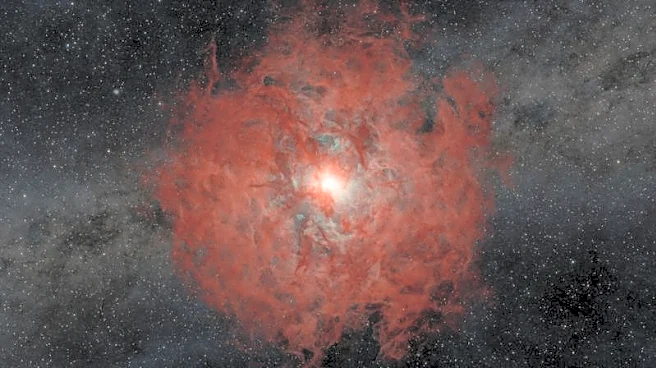
to post-main sequence stars, revealing that planets become rarer as their host stars age. This phenomenon occurs because elderly stars expand and exert tidal forces that can cause planets to decay in orbit, lose their atmospheres, or be completely engulfed. The study identified 456,941 post-main sequence stars and found 130 planets with close-in orbits, showing a significant decrease in the number of planets around older stars. This research provides insights into the future of our solar system, as the sun is expected to undergo similar processes in about 5 billion years.
Why It's Important?
Understanding the interaction between planets and aging stars is crucial for predicting the long-term fate of our solar system. The study highlights how tidal forces from expanding stars can lead to the destruction of planets, offering a glimpse into Earth's distant future. This research contributes to the broader field of exoplanet science, which has confirmed over 6,000 planets since the first discovery 30 years ago. The findings also emphasize the importance of metallicity, or the abundance of elements heavier than helium, in determining exoplanet occurrence rates. As older stars have lower metallicity, this factor could significantly impact the likelihood of planet survival. The study's insights could guide future observations and models, enhancing our understanding of planetary evolution and star-planet interactions.
What's Next?
Future observations, including those from the European Space Agency's Plato Mission set to launch in December 2026, will provide more sensitive data to complement TESS observations. These efforts aim to refine models by measuring metallicity and mass, potentially revealing minute orbital changes that indicate a planet spiraling towards its doom. Such discoveries will deepen our understanding of the coevolution of planets and their host stars, offering a more comprehensive view of the processes that govern planetary systems. Continued research in this area could lead to breakthroughs in predicting the fate of planets in other solar systems, as well as our own.
Beyond the Headlines
The study of planet-eating stars not only informs us about the future of our solar system but also raises questions about the ethical implications of space exploration and the search for habitable planets. As scientists uncover the mechanisms behind planetary destruction, it prompts reflection on humanity's role in preserving Earth and exploring other worlds. Additionally, the research highlights the cultural significance of understanding our cosmic origins and future, fostering a sense of connection to the universe and inspiring future generations to pursue scientific inquiry.