




What's Happening?
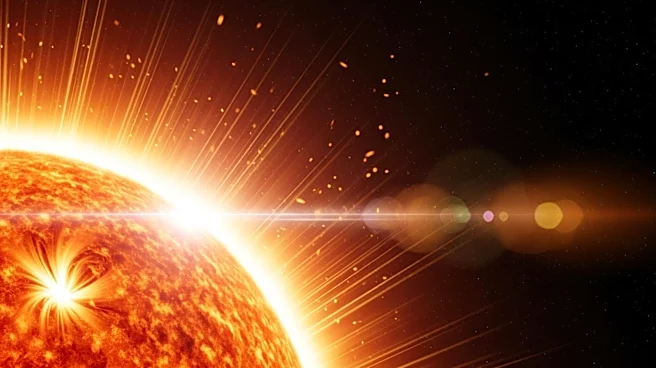
NASA's Parker Solar Probe has made significant discoveries regarding magnetic reconnection events on the Sun, which are responsible for solar storms that can impact Earth. During a solar flyby in 2022, the probe observed a magnetic reconnection event in the solar wind,
providing direct measurements of particles accelerated by this process. The findings revealed that protons and heavy ions are accelerated differently, challenging existing theories. Protons formed a dispersed beam, while heavier ions were directed in a straight line. These observations are crucial for refining theoretical models of magnetic reconnection and understanding how solar storms are powered.
Why It's Important?
The Parker Solar Probe's findings are vital for improving our understanding of solar storms, which can have significant impacts on Earth's technology and infrastructure. By uncovering the mechanisms behind magnetic reconnection, scientists can better predict and mitigate the effects of solar storms on satellites, power grids, and communication systems. This research enhances our ability to protect critical infrastructure and maintain technological resilience in the face of space weather events. The probe's discoveries also contribute to the broader field of heliophysics, advancing our knowledge of the Sun's behavior and its influence on the solar system.
What's Next?
The new insights from the Parker Solar Probe will inform future research and missions aimed at studying the Sun and its interactions with the solar system. Scientists will continue to analyze the data collected by the probe to refine models of magnetic reconnection and improve predictions of solar storm activity. Ongoing observations and future missions will build on these findings, enhancing our ability to understand and respond to space weather events. The probe's continued exploration of the Sun will provide further opportunities to uncover the mysteries of our closest star.