





What's Happening?
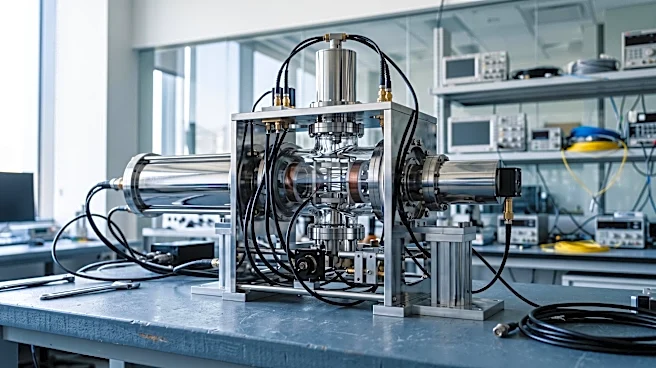
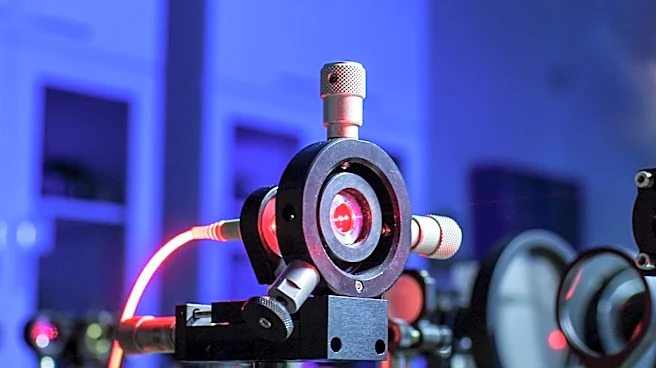
The Extreme Light Infrastructure – Nuclear Physics (ELI-NP) facility is at the forefront of laser-driven research, hosting two major complementary systems. One is a High Power Laser System (HPLS) capable of delivering pulses up to 10 PW, with additional
outputs of 1 PW/1 Hz and 100 TW/10 Hz. The other is a variable energy Gamma-ray system, which functions as a high-brilliance, narrow-bandwidth gamma beam source based on Compton backscattering. The facility's experimental programs encompass fundamental studies, including preparations for dark matter search experiments utilizing four-wave mixing and laser-plasma electron acceleration. Additionally, ELI-NP is exploring applications of laser-driven radiation sources, such as gamma-ray imaging with high-energy Bremsstrahlung radiation for non-destructive testing of dense objects, and the irradiation of biological cells using laser-driven particle and radiation beams. Dr. Liviu Neagu, a former PhD student from Kent now at ELI Bucharest, Romania, recently presented an overview of these capabilities and ongoing research.
Why It's Important?
The advancements at the ELI-NP facility hold significant importance for various scientific and industrial sectors. The high-power laser and gamma-ray systems enable groundbreaking research in nuclear physics and strong-field physics, potentially leading to new discoveries about the fundamental nature of matter and energy. The development of advanced gamma-ray imaging techniques offers improved spatial and temporal resolution for non-destructive testing, which can enhance quality control and safety in industries dealing with dense materials, such as aerospace and manufacturing. Furthermore, the ability to irradiate biological cells with laser-driven beams opens new avenues for medical research, including potential applications in cancer therapy and radiobiology. These technological capabilities position the U.S. and its international collaborators at the forefront of high-intensity laser and gamma-ray science, fostering innovation and economic growth through scientific breakthroughs.
What's Next?
Future work at ELI-NP will continue to focus on expanding its experimental programs. This includes further development of dark matter search experiments, which could provide crucial insights into one of the universe's greatest mysteries. Research into laser-plasma electron acceleration will also progress, potentially leading to more compact and efficient particle accelerators. In the realm of applications, ongoing efforts will refine gamma-ray imaging techniques to improve their efficacy in industrial settings. Additionally, studies on the irradiation of biological cells are expected to advance, potentially leading to preclinical trials for novel medical treatments. The facility will likely continue to host international collaborations and attract leading scientists, further solidifying its role as a global hub for high-power laser and gamma-ray research. The continuous development of these technologies could also spur the creation of new industries and specialized jobs.
Beyond the Headlines
The work at ELI-NP extends beyond immediate scientific and industrial applications, touching upon deeper implications for scientific methodology and international collaboration. The facility represents a significant investment in large-scale scientific infrastructure, highlighting the global commitment to pushing the boundaries of physics. The interdisciplinary nature of the research, combining nuclear physics, strong-field physics, materials science, and biology, fosters a holistic approach to scientific inquiry. Ethically, the development of advanced radiation sources necessitates careful consideration of safety protocols and responsible use, particularly in biological and medical applications. Culturally, such large-scale international projects promote scientific diplomacy and the sharing of knowledge across borders, contributing to a global scientific community. The long-term impact could include a paradigm shift in how we approach energy generation, materials science, and medical diagnostics and treatments, driven by the unique capabilities of high-power lasers and gamma-ray beams.