







What's Happening?
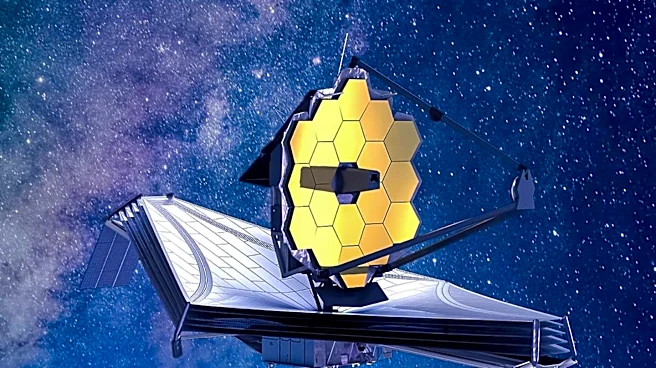
The James Webb Space Telescope (JWST), a collaborative project between NASA, ESA, and the Canadian Space Agency, is often described as the successor to the Hubble Space Telescope. Launched on December 25, 2021, the JWST features a 6.5-meter segmented
mirror, significantly larger than Hubble's, allowing it to collect nearly six times more light. Designed to operate primarily in the infrared spectrum, the JWST aims to explore a wide range of scientific topics, from the first galaxies in the universe to the study of exoplanets. The telescope is positioned approximately 1.5 million kilometers from Earth, orbiting the second Lagrange point (L2) of the Sun-Earth system.
Why It's Important?
The James Webb Space Telescope represents a major advancement in space observation technology, offering unprecedented capabilities in infrared astronomy. Its ability to observe distant galaxies and study the atmospheres of exoplanets could lead to groundbreaking discoveries about the origins of the universe and the potential for life beyond Earth. The JWST's enhanced sensitivity and resolution will provide deeper insights into cosmic phenomena, potentially reshaping our understanding of the universe. This mission also highlights international collaboration in space exploration, with significant contributions from European and Canadian partners.