




What's Happening?
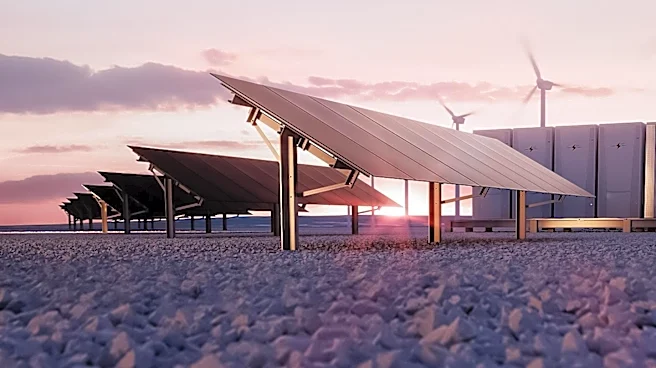
The Rhode Island Office of Energy Resources (OER) has announced that construction will commence in 2027 on two integrated solar carports, battery energy storage systems, and electric vehicle charging stations on the state's Capitol Hill campus. This $9.3
million project is funded by a $4.5 million federal earmark secured by U.S. Senator Jack Reed, matched with state funds from the Regional Greenhouse Gas Initiative. The initiative aims to increase the campus's renewable energy capacity to a total of 1 megawatt. The state has also secured a 5% safe harbor expenditure towards qualifying for the federal Clean Electricity Investment Credit (CEIC) under Section 48E, with expectations to receive an additional 30% to 40% of eligible project costs in tax year 2028. The systems must be operational by late 2027 to secure these federal tax credits.
Why It's Important?
This project represents a significant investment in renewable energy infrastructure for Rhode Island, demonstrating a commitment to clean energy and reduced carbon emissions at the state level. By leveraging federal funding and tax credits, the state aims to achieve substantial energy savings, estimated at $3.3 million in avoided energy costs and a reduction of 12,700 metric tons of carbon emissions over the project's lifetime. This initiative also serves as a model for other states and municipalities, showcasing how integrated solar, storage, and EV charging solutions can be deployed in public facilities. It supports the state's decarbonization mandates and advances its 'Lead by Example' program, encouraging broader private investment in renewable energy infrastructure.
What's Next?
Construction for the solar carports, battery storage, and EV charging stations is scheduled to begin in the first quarter of 2027. The critical deadline for the project is late 2027, by which time the systems must be fully operational to secure the federal Clean Electricity Investment Credit. Once completed, these installations, combined with existing rooftop solar panels, will provide enough solar-powered electricity to power approximately 190 homes annually. The project is expected to contribute to Rhode Island's goal of achieving zero-net electricity emissions by 2033, as mandated by the state's Renewable Energy Standard law. The success of this project could influence future state-led renewable energy initiatives and public-private partnerships.
Beyond the Headlines
This project highlights the increasing trend of integrating multiple clean energy technologies—solar generation, battery storage, and EV charging—into a single, cohesive system. This integrated approach maximizes efficiency, provides grid stability through energy storage, and supports the growing adoption of electric vehicles. The use of federal earmarks and tax credits underscores the critical role of federal policy in catalyzing state-level clean energy transitions. Furthermore, by implementing such projects on state property, Rhode Island is not only reducing its own carbon footprint and operational costs but also setting a tangible example for its citizens and businesses, potentially accelerating the broader adoption of these technologies across the state and region.