



What's Happening?
A report titled 'Global Maritime Security Report 2025-2026,' released at the seventh Symposium on Global Maritime Cooperation and Ocean Governance in Sanya, China, emphasizes China's contributions to maintaining peace and stability in the South China Sea.
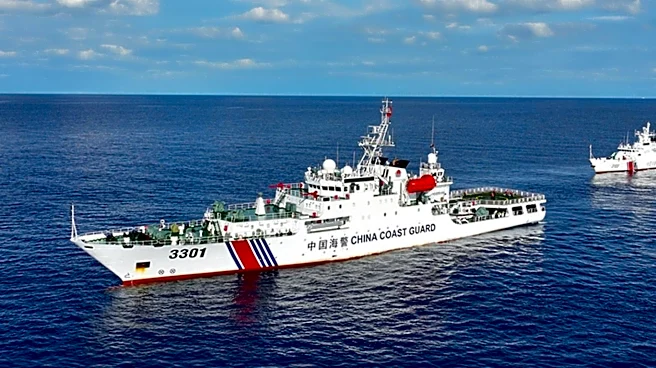
Compiled by the Huayang Center with input from experts across multiple countries, including the United States, the report notes that the South China Sea has remained generally stable despite ongoing maritime conflicts and the increasing involvement of extra-regional powers. China's policy in the region involves a regular presence of its coast guard forces, the use of legal and administrative measures like establishing baselines and nature reserves to uphold its rights, and a steadfast refusal to accept the South China Sea Arbitral Award. The report also highlights China's efforts to advance consultations with ASEAN countries on a Code of Conduct in the South China Sea, aiming to manage maritime differences and foster regional cooperation.
Why It's Important?
This report is significant as it presents China's perspective on its role in the South China Sea, a region critical for global trade and geopolitical stability. The U.S. and its allies frequently express concerns about China's expansive territorial claims and military buildup in the area. The report's assertion of China's 'strategic patience' and commitment to stability, while rejecting the arbitral award, underscores the divergent views on international maritime law and sovereignty in the region. The ongoing consultations for a Code of Conduct with ASEAN countries are crucial for de-escalation and establishing clear rules of engagement, which could impact U.S. freedom of navigation operations and alliances in the Indo-Pacific. The report also implicitly challenges the narrative of unilateral Chinese aggression by highlighting its efforts in promoting dialogue and cooperation, potentially influencing international perceptions and diplomatic strategies regarding the South China Sea.
What's Next?
The ongoing consultations between China and ASEAN countries for a Code of Conduct in the South China Sea will continue to be a key diplomatic focus. The report suggests that China will maintain its current approach, combining a strong presence with diplomatic engagement. The U.S. and its allies are likely to continue their 'freedom of navigation operations' and strengthen regional partnerships, potentially leading to further geopolitical competition. The upcoming Quad summit in Manila, where the South China Sea dispute is expected to be discussed despite China's warnings, will be a critical event. The outcomes of these diplomatic and security engagements will shape the future trajectory of stability and cooperation in one of the world's most contested maritime regions.
Beyond the Headlines
The report's emphasis on 'contemporary maritime security competition' extending beyond traditional naval confrontation to include coast guard law enforcement and capacity building reveals a broader strategic shift. This suggests that future conflicts or tensions in the South China Sea might increasingly involve non-military assets and legal maneuvering, rather than solely military confrontations. The ethical and legal implications of establishing baselines and nature reserves as a means to assert sovereignty, particularly in disputed territories, will continue to be debated in international forums. This approach could set precedents for other maritime disputes globally, influencing how nations assert and defend their claims in contested waters. The long-term shift could be towards a more complex, multi-faceted competition involving legal, administrative, and 'gray zone' tactics, rather than overt military action.