
What's Happening?
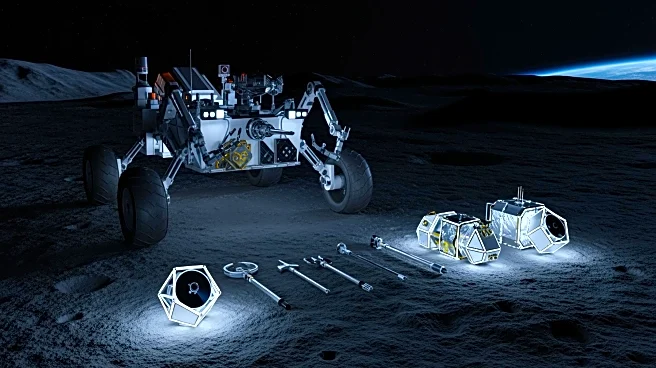
NASA is employing robotic missions to tackle various challenges associated with future human exploration of the Moon and Mars. These missions are focused on understanding and mitigating issues such as lunar
dust, radiation exposure on Mars, and locating water resources on the Moon. The use of robots is not seen as a replacement for human missions but as a complementary effort that lays the groundwork for human exploration. Robots are tasked with scouting, measuring, and testing environments, providing critical data that will inform human missions. For instance, the DUSTER instrument on Artemis IV will study lunar dust behavior, while Mars missions are collecting data on radiation exposure to aid in planning safe human activities on the planet.
Why It's Important?
The integration of robotic missions into space exploration is crucial for ensuring the safety and success of future human missions to the Moon and Mars. By addressing environmental challenges such as radiation and dust, NASA aims to create a sustainable framework for human presence in space. The data collected by robots will help in designing habitats, planning surface missions, and establishing daily routines for astronauts. This approach not only enhances the safety of human explorers but also maximizes the efficiency and effectiveness of space missions. The collaboration between robotic and human missions represents a strategic shift in space exploration, emphasizing the importance of technology in overcoming extraterrestrial challenges.
What's Next?
Future steps involve the continued deployment of robotic missions to gather more detailed data on lunar and Martian environments. NASA plans to use this information to refine mission planning and develop technologies that will support human activities in space. The focus will be on improving the accuracy of water mapping on the Moon and enhancing radiation protection strategies on Mars. As robotic missions continue to operate, they will provide ongoing support and data for human missions, ensuring that astronauts are well-prepared for the challenges they will face. This ongoing collaboration between robots and humans is expected to evolve, with robots playing an increasingly integral role in space exploration.
Beyond the Headlines
The use of robots in space exploration raises important ethical and operational considerations. The reliance on robotic missions highlights the need for robust technological systems that can operate autonomously in harsh environments. Additionally, the data collected by these missions must be carefully managed and interpreted to ensure accurate and reliable information for human missions. The collaboration between robots and humans also prompts discussions about the future of space exploration and the potential for long-term human settlement on other celestial bodies. As technology advances, the role of robots in space exploration is likely to expand, offering new opportunities and challenges for scientists and engineers.