



What's Happening?
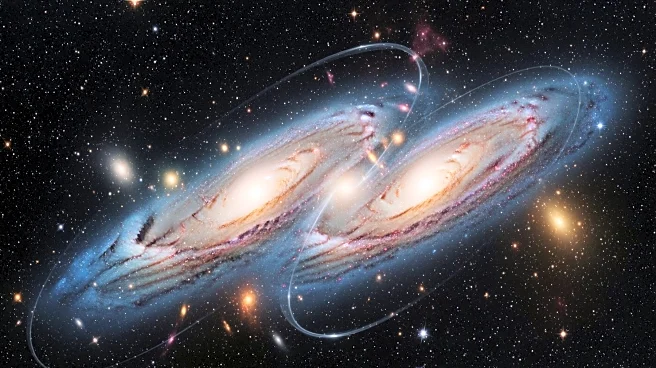
The European Space Agency's Euclid Space Telescope has captured a striking image of a galaxy merger, showcasing its capabilities in mapping the cosmos. Launched in 2023, Euclid is on a six-year mission to observe billions of galaxies, aiming to enhance
our understanding of galaxy formation and the universe's expansion. The recent image features the spiral galaxy NGC 646, located 392 million light-years from Earth, and highlights Euclid's potential to reveal insights into dark matter and dark energy. These phenomena are crucial to understanding the universe's structure and expansion, as dark matter influences galaxy formation, and dark energy drives the universe's accelerated expansion.
Why It's Important?
Euclid's mission is significant for advancing our knowledge of the universe's fundamental components, particularly dark matter and dark energy, which remain largely mysterious. By mapping the distribution of galaxies and their movements, Euclid can provide data that helps scientists infer the presence and behavior of dark matter. This research is essential for developing a comprehensive model of the universe's evolution and could lead to breakthroughs in cosmology. The telescope's findings will also complement other astronomical research, potentially leading to new theories about the universe's origins and future.
What's Next?
Euclid is set to release its first formal batch of data next year, covering about 14% of its final survey area. This data will be crucial for astronomers seeking to understand the distribution and effects of dark matter and dark energy. As the mission progresses, Euclid's observations will continue to provide valuable insights into the universe's structure and dynamics. The scientific community eagerly anticipates these findings, which could reshape our understanding of cosmology and influence future space missions and research initiatives.