



What's Happening?
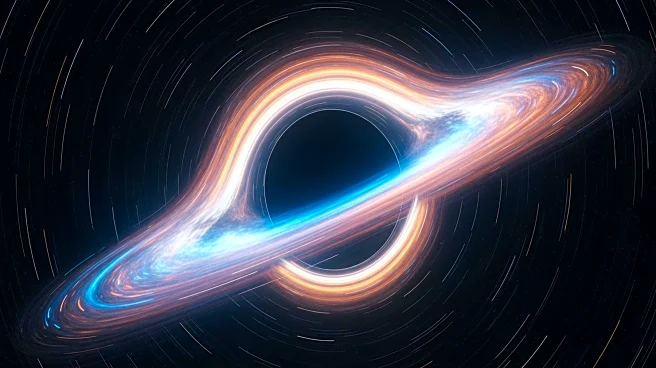
Scientists have observed a supermassive black hole exhibiting a phenomenon known as frame-dragging, where the black hole's rotation pulls on space and time, as it consumes a nearby star. This event, identified as AT2020afhd, involved a star being torn
apart by the black hole's gravity, forming a disk of gas that emitted X-ray and radio signals. These signals showed a regular pattern of changes, suggesting the inner disk was wobbling, consistent with predictions from Einstein's theory of general relativity. The study, utilizing data from NASA's Neil Gehrels Swift Observatory and the Karl G. Jansky Very Large Array, provides new insights into black hole spin and their interaction with surrounding matter.
Why It's Important?
This discovery is significant as it offers direct evidence of frame-dragging, a concept that has been challenging to observe around black holes. The findings enhance understanding of black hole dynamics and tidal disruption events, where stars are broken apart by black holes. This research not only confirms theoretical predictions but also opens new avenues for studying black hole properties and their effects on nearby matter. The ability to observe such phenomena directly could lead to advancements in astrophysics and a deeper comprehension of the universe's fundamental forces.
What's Next?
Future studies may employ similar methods to explore black hole characteristics in other galaxies. Continued monitoring of tidal disruption events could yield further data on space-time behavior under extreme conditions. This research could also inspire new technologies and methodologies for observing cosmic phenomena, potentially leading to breakthroughs in understanding the universe's structure and evolution.