





What's Happening?
Nevada has formally submitted its proposal to host the envisioned United States Space Academy, a federal institution focused on U.S. space interests. The state's bid, filed by the Nevada Governor's Office of Economic Development, has received strong backing
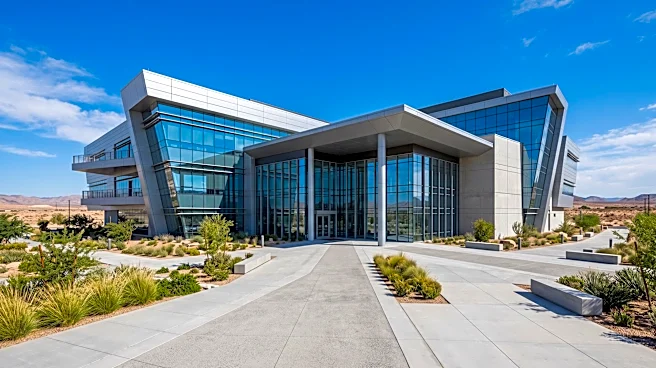
from its congressional delegation, including Sens. Catherine Cortez Masto and Jacky Rosen, and Reps. Susie Lee, Steven Horsford, Dina Titus, and Mark Amodei. These lawmakers sent a letter to NASA Administrator Jared Isaacman, highlighting Nevada's unique qualifications. They cited the state's existing federal training and test infrastructure, active NASA lunar training capabilities, nationally recognized research universities, a growing aerospace and defense workforce, and its interior location as key advantages. The proposal suggests a campus adjacent to the planned Las Vegas Spaceport, with an estimated $905 million permanent campus capable of accommodating up to 4,000 cadets by 2031.
Why It's Important?
The establishment of a U.S. Space Academy represents a significant national initiative to bolster American leadership in space exploration and technology. For the state selected to host it, the economic and educational benefits would be substantial. Hosting the academy would bring considerable investment, create numerous high-tech jobs, and attract a skilled workforce, thereby boosting the local economy and fostering a robust aerospace ecosystem. Nevada's bid emphasizes its existing infrastructure, such as the Nevada Space Proving Grounds and various Air Force bases, which could provide immediate operational advantages and reduce startup costs. Furthermore, the presence of such an academy would elevate the state's academic institutions, like UNLV and UNR, by fostering collaborations in aerospace research and development, positioning Nevada as a major hub for space education and innovation.
What's Next?
The presidential commission, established by President Trump's executive order on August 28, 2026, is tasked with planning the NASA-led federal academy and is due to submit its report, including site-selection recommendations, by December 26. Following this report, a formal site-selection process will likely commence, with Nevada competing against other bidding states such as Alabama, Florida, Ohio, and Texas. If Nevada is chosen, the next steps would involve securing funding, commencing construction of an interim campus by 2028 to accommodate initial cadets, and then proceeding with the development of the larger permanent campus by 2031. The United Spaceports Corporation, which owns land near the proposed site, has already outlined a development plan, indicating readiness to proceed should Nevada be selected.
Beyond the Headlines
The competition to host the U.S. Space Academy reflects a broader national strategy to maintain and advance American dominance in space. Beyond the immediate economic benefits for the chosen state, the academy aims to cultivate the next generation of space leaders, ensuring a continuous pipeline of talent for NASA, the military, and the private aerospace industry. This initiative underscores the increasing importance of space as a domain for national security, economic growth, and scientific advancement. The academy's curriculum, spanning aerospace engineering to advanced welding and flight simulation, highlights the multidisciplinary nature of modern space endeavors. The emphasis on hands-on training and commercial space innovation suggests a forward-looking approach, preparing cadets not just for traditional space roles but also for emerging opportunities in the rapidly evolving commercial space sector.