



What's Happening?
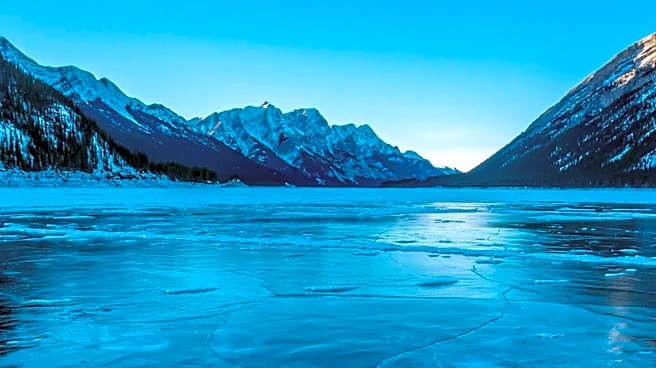
A recent study published in the Proceedings of the National Academy of Sciences has found that lakes across the Northern Hemisphere are losing their winter ice cover at an accelerated rate. Researchers tracked 724 lakes from 2000 to 2022, discovering
that as winter temperatures rise above critical thresholds, ice loss sensitivity can increase up to 22-fold. The study highlights that lakes are losing ice faster in spring than they are delaying freezing in autumn, leading to a potential reduction of 40 days of winter ice cover by the end of the century if greenhouse gas emissions remain high. The research emphasizes the role of large-scale climate conditions over individual lake characteristics in determining ice loss.
Why It's Important?
The findings of this study have significant implications for freshwater ecosystems and communities that rely on stable winter ice cover. The loss of ice affects water temperature regulation, aquatic life, and the natural balance of ecosystems. As more lakes cross critical temperature thresholds, the health of these ecosystems could be compromised, impacting water quality and biodiversity. Additionally, communities that depend on frozen lakes for activities such as fishing and transportation may face economic and social challenges. The study underscores the urgent need for addressing climate change to prevent further ecological and societal disruptions.
What's Next?
If current emission trends continue, the number of lakes crossing critical temperature thresholds is expected to rise sharply, with about 70% of the studied lakes potentially affected by the end of the century. This could lead to abrupt and potentially irreversible shifts in lake ice regimes. Policymakers and environmental organizations may need to implement strategies to mitigate climate change impacts and protect vulnerable ecosystems. Further research could focus on developing adaptive measures for communities and ecosystems at risk.