







What's Happening?
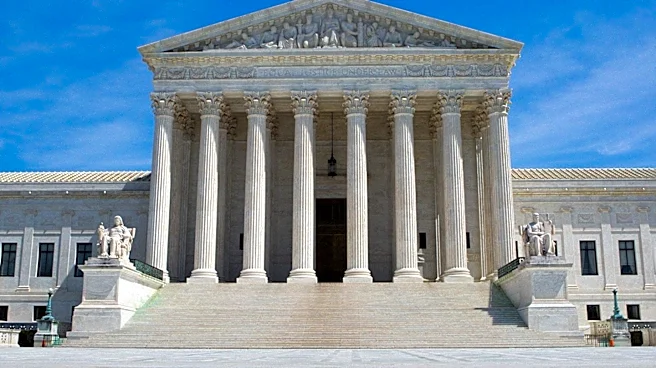
The South Carolina Law Review highlights that the U.S. Supreme Court's criminal procedure decisions during the Prohibition Era (1920-1933) continue to have a profound and lasting impact on contemporary legal doctrine. Despite the repeal of the Eighteenth
Amendment in 1933, the precedents set by the Taft Court in cases like *Carroll v. United States* and *Olmstead v. United States* remain entrenched. These decisions fundamentally altered the interpretation of the Fourth and Fifth Amendments, particularly concerning police discretion, probable cause standards, and the admissibility of evidence obtained through government misconduct. The article argues that these Prohibition-era rulings, often favoring law enforcement, laid the groundwork for many aspects of modern criminal procedure, including the 'automobile exception' to warrant requirements and the 'dual sovereignty' doctrine.
Why It's Important?
The enduring legacy of Prohibition-era Supreme Court decisions is critical because it demonstrates how historical legal interpretations can shape current civil liberties and law enforcement practices. The *Carroll* decision, for instance, established the 'automobile exception,' granting police broader authority to search vehicles without a warrant, a principle still widely applied today. Similarly, *Olmstead* set a precedent for judicial tolerance of police misconduct, influencing how courts address illegally obtained evidence. These rulings have contributed to the expansion of police discretion and the dilution of probable cause standards, impacting countless individuals' Fourth and Fifth Amendment rights. Understanding this historical context is essential for evaluating the origins and implications of current criminal justice policies and for recognizing how past legal battles continue to resonate in contemporary debates over policing and individual freedoms.
What's Next?
The continued relevance of these Prohibition-era cases suggests ongoing legal challenges and debates regarding the balance between law enforcement powers and individual rights. Legal scholars and civil rights advocates may continue to scrutinize these foundational precedents, potentially leading to calls for re-evaluation or limitations on their application in modern contexts. Future Supreme Court cases involving search and seizure, probable cause, or government misconduct could revisit the historical underpinnings of these doctrines. The ongoing discussion about police accountability and the scope of constitutional protections will likely keep these historical rulings at the forefront of legal discourse, influencing legislative efforts and judicial interpretations for years to come.
Beyond the Headlines
The deep-seated influence of Prohibition-era rulings on modern criminal procedure reveals a complex interplay between societal pressures, judicial philosophy, and constitutional interpretation. The Taft Court's decisions, made during a period of intense social and political upheaval, prioritized law enforcement efficiency over what had previously been robust protections for individual liberties. This historical shift highlights how moments of perceived 'crisis' can lead to lasting changes in legal frameworks, often with unintended consequences for future generations. The article implicitly raises questions about judicial activism, the role of the Supreme Court in shaping public policy, and the long-term impact of legal precedents that may have been influenced by the prevailing moral and political climate of their time. It underscores the idea that legal history is not merely academic but actively shapes the lived experiences of citizens today.